Nature
 PUBLISHED
 2
2


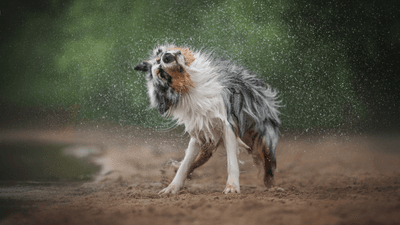


When hairy mammals feel something on their back, they’ll pull out the “wet dog shakes”. If you’ve ever been within the splash zone of a dog just getting out of the pool, you’ll likely have been on the receiving end of its efficacy. We’ve all seen it, but the neural mechanisms underpinning the behavior have remained something of a mystery – until now.
While it’s fun to watch for the silly faces dogs make when they do it, this shaking behavior also serves an important purpose as it can help them to rid their bodies of irritating and potentially damaging contaminants. Understanding how it happens can therefore inform how and why it’s been evolutionarily conserved across so many furry mammals.
We think C-LTMRs may also be involved in tickling sensations.
Dr Dawei Zhang
Mice are another species that exhibit wet dog shakes, and so a team of scientists used them as a model to explore the neurobiological foundations of the behavior. Their investigations identified a type of light-touch-sensitive mechanoreceptor on the skin that mediates the evolutionarily conserved behavior, involving the protein Piezo2 and C-fiber low-threshold mechanoreceptors, or C-LTMRs.
You can elicit a wet dog shake in a mouse by putting drops of oil on its back, but to work out the mechanisms behind the behavior, the team needed to get more technical. One approach they employed involved using optogenetics, which enables scientists to control specific neurons using light. By using light in this way, they realized they could trigger a wet dog shake in the mice, even when no oil droplets were put on their backs. They also used ablation, which involves removing or disabling neurons – and when the team ablated C-LTMRs, the mice stopped shaking as much.
C-LTMRs' primary role is to innervate the hair follicles of the undercoat for furry mammals, and they’re involved with pleasant affective touch (aka the reason good boys like pets so much). Those same mechanoreceptors appear to also serve a functional role when something sticky gets on a fluffy mammal’s back, sending a signal to spinoparabrachial neurons that then pass the message on to the brainstem.
We know this because when the team inhibited spinoparabrachial neuron synapses, they couldn’t get a wet dog shake out of the mice using optogenetics or actual physical oil droplets. The same disruption was seen when they inhibited the excitatory neurons in the part of the brainstem that was on the receiving end of the spinoparabrachial neurons’ messages.
Now, we humans might not be covered in fur, but it’s possible this neurobiological pathway may be behind our greatest Achilles heel: the dreaded tickle.
“When C-LTMRs were first discovered in cats, scientist Zotterman (published in 1939) found that C-LTMRs continued to respond/fire after the stimulus (stroking the cat's hairy skin) had ceased, while many other sensory neurons stopped firing when the stimulus stopped,” first author Dawei Zhang of the Program In Neuroscience at Harvard University told IFLScience. “This aligns with the lingering tickling sensation in humans even after the stimulus has ceased and led him to hypothesize that C-LTMRs convey tickling sensations.”
“In our experiments, we observed that wet dog shakes were often coupled with scratching behaviors in mice. When we ablated C-LTMRs, in addition to a reduction in WDS, we also saw a reduction in scratching. Therefore, we think C-LTMRs may also be involved in tickling sensations.”
A fascinating insight into animals that shake it off, then, and in the future the team may turn their sights to those that don’t seem to do the wet dog shake.
“It would be interesting to explore how these sophisticated motor outputs are generated by the nervous system, beyond just understanding the sensory aspect,” added Zhang. “It would also be intriguing to understand why some animals don't perform wet dog shakes—whether it’s due to differences in sensory, motor, or other parts of the nervous system.”
The study is published in the journal Science.