Humans
 PUBLISHED
 1
1


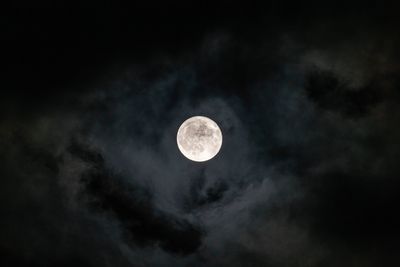


In 2023, a study of 200,000 healthcare workers suggested that these professionals used their panic buttons more frequently during specific times. Perhaps you'd think this occurred during festival events or at weekends when people have been drinking, but you’d be wrong. Instead, the study claimed that these workers often used these alarms, designed to alert security personnel of an incident, during full Moons. According to the report by Canopy, the company who produce the alarms, there is a 9 percent increase in their use during this lunar phase.
To some people, this information may not come as a shock. There is a long-held belief that people are influenced by the Moon, especially the full Moon. In fact, in 2007, police in the southeast of the UK went as far as to deploy extra officers during full Moons because they believed violent incidents occurred more frequently during these times.
The Moon is not just responsible for violence either, so some people believe. Ask anyone whether the Moon influences human behavior or activities and, in addition to a spike in violence, they may also tell you that more babies are born during full Moons. In India, news articles published as recently as 2019 discourage people from eating during a lunar eclipse as the Moon is believed to poison food as its being prepared.
Clearly something is going on here, but is it really that the Moon is influencing people or is there something else to it? Well, the answer is complex, but it’s mostly negative – there’s little coherent evidence to support any of the above claims. In fact, there have been multiple efforts to find a connection between the lunar cycle and human behavior, and the results have been consistently inconclusive.
Sure, some studies suggest a correlation between the lunar cycle and certain human activities – such as menstruation, sleep cycles, or individual cases of mental illness – but they have often relied on small sample sizes. Even the data from Canopy may not reflect a real trend but rather highlight the presence of this wider belief among medical workers, who then expect more violent behavior during full Moon nights. If anything, this result was a minor quirk embedded within a broader dataset demonstrating just how dangerous hospitals in the US can be for their staff.
Despite these limitations, however, the belief that the Moon meddles with people’s minds is deeply ingrained in our culture. So where does this come from? As with many strands of popular culture, the story is far older than people think and blends folklore and superstition with medical ideas that we abandoned long ago.
Moonstruck
People have been blaming the Moon for weird behaviors for centuries. You’re probably familiar with the use of the word “lunacy” or “lunatic” to describe someone as “mad” in some way. This word is the root for understanding the wider beliefs in the malign powers of the Moon, and it has a long history.
The word “lunacy” comes from the Latin lunaticus, which means “moonstruck”, and essentially refers to a person who experiences recurring mental disturbances during the different phases of the Moon. It first appears in writing in relation to mental illness in the 13th century but become more common as the medieval period progressed.
In the 16th century, Paracelsus, an influential Renaissance medical revolutionary, wrote that “mania has the following symptoms: frantic behavior, unreasonableness, constant restlessness and mischievousness. Some patients suffer from it depending on the phases of the Moon.”
Shakespeare, for instance, loved to refer to “lunatics” in his work, with Othello blaming the Moon for inducing madness. He references the Moon’s influence again in other plays, such as The Merry Wives of Windsor, The Taming of the Shrew, A Midsummer Night’s Dream and so on. Even Milton used “moonstruck” in Paradise Lost to refer to insanity.
By the 18th century, the term was being recognized by English jurists with specific reference to madness exacerbated by the lunar cycle. Although today we regard the term “lunatic” as a pejorative, its codification in legal writing at this point was a practical one as people who were believed to be insane – non compos mentis – had restrictions on their legal rights as citizens.
Even in the 19th century, both in the US and Britain, “lunatic” was a socially and medically accepted term, but it was most prominent in reference to “lunatic asylums”. It was only after the 1870s and especially during the 20th century that we saw a gradual turn away from the term in favor of things like “person of unsound mind” or “mental illness”.
Today, the term “lunatic” is not recognized as a legitimate label for mental illness, but it was still present in certain legal documents until very recently.
It is clear there is a strong cultural and historical legacy connecting the Moon to mental illness, but where did it come from? To appreciate that, we have to go even further back to a way of viewing the human body in relation to the world around it.
It’s written in the stars
During the first century CE, the Roman naturalist Pliny the Elder explained how the full Moon produced more “dew” buildup on Earth, which led to human brains becoming “unnaturally moist”. This, he argued, led people to have “epileptic attacks”. The same mechanism was said to influence insane people too, referred to as “maniacs”. Here the idea was that the Moon transformed the normal fluid found in the brain – black bile – into another vital bodily fluid: phlegm. This resulted in a person becoming mentally unstable.
To understand how this makes sense, we have to abandon the way we think about health and sickness today and enter into a very different way of thinking. In particular, we have to understand how humoral medicine – the medical tradition of ancient Greeks and Romans, and later the dominant tradition in Europe and elsewhere – conceptualized the relationship between the human body and the world (and the heavens) surrounding it.
Humoral medicine held that a person’s health depended on the balance of four bodily fluids (blood, phlegm, yellow bile, and black bile) that everyone had in varying levels. When healthy, a person was living in the right way and eating the right things that kept these humors correctly balanced. However, eating the wrong foods, exposing yourself to the wrong conditions (bad weather, chills, high temperatures, or moist climates), or breathing bad airs (malaria means “bad air”) could result in one or more humors to become imbalanced, producing sickness.
Clearly the human body was believed to be vulnerable to many terrestrial factors. But if that wasn’t bad enough, the heavens also liked to throw challenges at us.
The idea that the stars and planets can impact humans in some way is easy to appreciate. Anyone who has observed the world around them can see how the lunar cycle matches the timings of the tides and could affect the growth of certain living things. If the Moon could do this, why couldn’t other celestial bodies? Moreover, if the Moon influences conditions on Earth and human health is particularly vulnerable to changes, then surely it must play a role in sickness and health?
For much of recorded history for people across the world, this was an uncontroversial truth.
Given this worldview, if a physician wanted to help their patients, they needed to be experts on the heavens as well as the human body. In particular, the physicians could anticipate a patent’s recovery or decline based on the phases of the Moon. By consulting start charts, learned practitioners could even explain disasters such as major outbreaks of plague – the Black Death was blamed on the conjunction of Jupiter, Saturn and Mars in 1345.
The use of astrological medicine, as it is known, was deeply influential for centuries, particularly in the later Middle Ages into the Early Modern era. It only started to lose prominence with the gradual rise of more scientific forms of medicine during the late 18th and early 19th century, but as we have seen, some of this mode of thinking have lingered to this day, albeit free from its intellectual framework.