Humans
 PUBLISHED


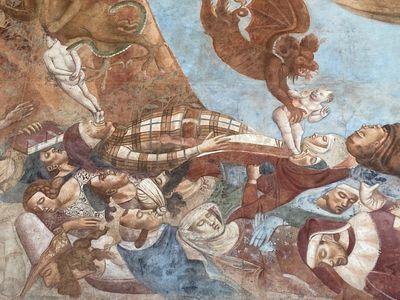


Volcanoes may have played a pivotal role in the Black Death, the bubonic plague pandemic that ravaged 14th-century Europe.
The Black Death tore through Europe, as well as parts of Asia and North Africa, between 1347 and 1353 CE. Caused by the plague bacterium, Yersinia pestis, the catastrophic pandemic killed up to 60 percent of the population in some regions, sparking a profound social and economic transformation.
It’s believed it originated in fleas living on the backs of wild rodents in central Asia and reached Europe via the Black Sea region, but the reasons behind the timing of its onset are not fully understood. Plague has infected humans for at least 5,000 years, so why did it suddenly spread like wildfire in 14th-century Europe?
Volcanoes might have some of the answers. In a new study, scientists at the University of Cambridge and the Leibniz Institute for the History and Culture of Eastern Europe have found sturdy evidence that there was an outburst of volcanic activity in the tropics around 1345 CE, just before the Black Death outbreak.
The researchers reached this conclusion by analyzing European tree rings, estimating volcanic sulfur levels from ice cores in Antarctica and Greenland, and examining contemporary written accounts.
The eruption filled the atmosphere with so much volcanic gas and ash that it temporarily shook up the global climate. The team believes that this also triggered a spate of unusually cold and wet summers in 1345, 1346, and 1347 across much of southern Europe.
Bad weather led to poor harvests and starvation. In an attempt to ward off full-blown famine, powerful Italian maritime city-states, such as Venice and Genoa, had to make peace with the Mongols of the Golden Horde and import huge quantities of grain from around the Black Sea region in 1347 CE.
This surge in grain-loaded ships, while vital to stave off famine, may have inadvertently transported plague-infected fleas and rats across trade routes to Europe, significantly increasing the risk of the disease spreading.
“For more than a century, these powerful Italian city states had established long-distance trade routes across the Mediterranean and the Black Sea, allowing them to activate a highly efficient system to prevent starvation,” Dr Martin Bauch, a historian of medieval climate and epidemiology from the Leibniz Institute for the History and Culture of Eastern Europe, said in a statement.
“But ultimately, these would inadvertently lead to a far bigger catastrophe.”
The study posits that the Black Death ripped through Europe because a perfect storm of factors converged: a highly virulent strain of Yersinia pestis, densely populated cities with poor sanitation, and far-reaching trade networks that connected the globalising world. When the unknown volcano erupted, it set off a domino effect that turbocharged the ideal conditions for the plague to spread.
“Although the coincidence of factors that contributed to the Black Death seems rare, the probability of zoonotic diseases emerging under climate change and translating into pandemics is likely to increase in a globalised world,” explained Professor Ulf Büntgen from the University of Cambridge’s Department of Geography. “This is especially relevant given our recent experiences with COVID-19.”
The study is published in the journal Communications Earth & Environment.



 5
5