Nature
 PUBLISHED
 22
22


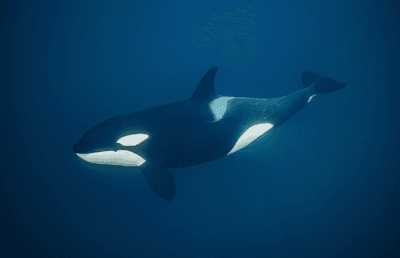


Orcas are easily recognized by their jet-black bodies punctuated with striking white markings, most notably the “eye patch” on their head, which makes them appear like an ominous masked supervillain. But these markings aren't just eye-catching to humans – they're an ingenious evolutionary tool.
The black-and-white coloring of orcas is primarily a matter of camouflage. The majority of their underbelly is white, which blends into the sunlit water when viewed from below, while most of their top half is black, merging into the ocean depths when viewed from above. This two-sided coloration, known as countershading, is found across species in the animal kingdom.
However, they also possess odd patches that don’t fit within this regime. Just behind their dorsal fin, they have a grey-ish “saddle patch,” as well as the signature white “eye patch” on the side of their heads.
This is an example of disruptive patterning, which works by breaking up the outline of a figure using a strongly contrasting pattern. It’s the reason why camouflaged animals, as well as camouflage gear used by the military, are rarely a single block color. A patchwork of bold, contrasting patterns does a far better job of confusing the eye and concealing shape than a single shade can.

Orcas are apex predators – they didn’t earn the nickname "killer whales" for nothing – so this camouflage isn’t used to hide from would-be attackers, but to help them stealthily sneak up on their prey, which includes almost anything that moves.
Not all orca pigmentation is the same, though. Scientists have documented how populations of orcas found in different parts of the world’s oceans have their own unique patterning, almost like gang insignia or team colors. The variation is so prominent that researchers can use the patch shapes to ID pods of killer whales and use them to track their behavior.
A study of orcas in the North Atlantic found that pods from Norwegian, Icelandic, British, Spanish, and Greenlandic oceans all have varying eye patch shapes. For instance, the pod that swam near the Hebrides in northern Scotland had a distinctive “sloping” eye patch that was vividly different from the others.
Even more striking differences have been observed among orcas in the Southern Ocean around Antarctica. Researchers have classified them into several distinct ecotypes – Types A, B, C, and D – each with its own unique markings, behaviors, and territorial range.
Orcas don’t mess around, just ask any seal, and their distinctive markings are a beautiful expression of the cunning and power that keeps them at the top of the ocean’s fish-eat-fish food chain.