Culture and Society
 PUBLISHED


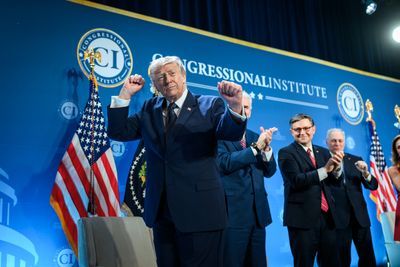


The waging of the War on Drugs is perhaps the most enduring legacy of the Nixon and Reagan administrations. Initiated in part due to the anti-war sentiment of the LSD-fueled counterculture of the 1960s, the vilification of mind-altering substances remained a flagship issue championed by Republicans and conservatives for decades – but not anymore.
In April of this year, US President Donald Trump signed an executive order directing the FDA and other regulatory bodies to accelerate research into the therapeutic potential of psychedelics, with a view to officially recognizing some of these compounds as medicines for certain mental health conditions.
Flanking him at the signing were not tie-dye-clad hippies but influential conservative figures with strong links to the military and the Bible belt. That’s quite a U-turn, so how did we get here?
Reframing psychedelics
It may seem like the political right has suddenly discovered psychedelics, but that’s not exactly the case. Instead, what’s happened is that the growing use of these substances among certain Republican-leaning factions has finally coalesced into a coherent narrative that fits with conservative values.
That narrative is driven by military veterans – a group that is disproportionately affected by post-traumatic stress disorder (PTSD), depression, and traumatic brain injuries, and which therefore stands to benefit significantly from the legal regulation of psychedelic medicines.
“Since 9/11, we’ve lost over 21 times more veteran lives to suicide than on the battlefield,” explained Trump at the signing of the executive order. “[T]oday, we’re bringing them new hope.”
Until now, that hope had existed in underground psychedelic treatments or trips to Mexico, where numerous unlicensed clinics offer treatment with a hallucinogenic alkaloid called ibogaine.
Derived from the iboga shrub (Tabernanthe iboga) that grows predominantly in Gabon, ibogaine has received far less scientific attention than psilocybin, LSD, or MDMA, but a growing number of anecdotal reports hint at its potential to treat PTSD, depression, addiction and other conditions commonly experienced by veterans.
“These are conditions that are incredibly recalcitrant to standard treatments, so many people who have these problems don't have a lot of good avenues to get them dealt with in any meaningful way,” says psychiatrist Albert Garcia-Romeu from John Hopkins University.
“But a lot of former military people with those kinds of issues have had experiences [with psychedelic therapy] that have been very helpful for them,” he tells IFLScience.
As these experimental treatments have become increasingly popular among veterans, psychedelics have been transformed from symbols of an anti-war counterculture into medicines for people who have been injured while serving their country.
Once framed as a response to the veteran suicide crisis, supporting psychedelic research becomes compatible with Republican ideals such as patriotism, family values, medical freedom - and the populist hostility to government bureaucracy that is so fundamental to Trump’s political messaging.
Why ibogaine?
The accumulation of positive reports over many years eventually translated to political action through organizations like Veterans Exploring Treatment Solutions (VETS), which helped drive a landmark law in Texas in 2021 that ordered more research into the use of psychedelics to treat veterans with PTSD.
That this happened in Texas is particularly significant, given that the state is a Republican stronghold and also has the highest concentration of veterans in the US.
The bill was backed by the state’s Republican former governor Rick Perry, who also co-founded the Americans for Ibogaine campaign alongside conservative lawyer and Universalist Christian W. Bryan Hubbard. The latter was among the first to shake hands with Trump in the Oval Office following the signing of April’s executive order.
Hubbard in particular is credited with putting ibogaine on the conservative agenda by framing it as a drug that can bring users closer to God. He and Perry were both influential in drumming up support for a $50 million funding package for ibogaine research, which was approved by Texas governor Greg Abbott in 2025.
I have no problem with the fact that Joe Rogan put it on Trump’s radar screen. In fact, I’m really thankful that he did.
Matthew Johnson
Yet the pair’s biggest contribution came, somewhat weirdly, when they appeared on the Joe Rogan Experience podcast in early April. Knowing the relationship their host has with the President, they half-jokingly asked him to text Trump requesting more ibogaine research. Trump’s reported response was bizarrely unhesitant: “Sounds great. Do you want FDA approval?”
Within days, the executive order was signed, promising $50 million of federal funds for research on ibogaine. And while some on the left may feel aggrieved that a text message from one of Trump’s bros was all it took to reshape the political agenda, this unexpected development represents a massive opportunity for scientists at the forefront of psychedelic research.
“With Joe Rogan getting the ball rolling, I just see that as part of the political reality,” says Matthew Johnson, a professor of psychedelics and consciousness research at Johns Hopkins.
“Everyone is vying for the president's attention, so I have no problem with the fact that Joe Rogan put it on Trump’s radar screen. In fact, I’m really thankful that he did,” he told IFLScience.
Johnson also points out that we didn’t reach this point because of Rogan. Over the past few decades, the scientific evidence supporting the potential benefits of psychedelics has been piling up, all of which fully justifies the political swing towards increasing access to these compounds.
“If it was Joe Rogan alone asking for this, I’d say ‘hold on, this doesn’t seem right’,” says Johnson. “But this is coming on top of 20 years of research.”
Even after Trump’s executive order, research - rather than politics - will continue to call the shots in terms of what actually happens to psychedelics in the US.
“From what I've seen, it appears that there is enough level of oversight that ibogaine is not just going to be out there for people to use next week,” says Garcia-Romeu. “There’s going to be due diligence, and the government is going to allow people to do the research so that we can see if it works and if it's dangerous.”
What the order will do, however, is allocate federal dollars to psychedelic research that were previously very difficult to secure. This will undoubtedly accelerate the field, although even with the likes of Hubbard, Perry, Trump, and Robert F. Kennedy, Jr. touting the benefits of ibogaine, the road to regulatory approval is still set to be a long one.
“One of the things that some of the central decision-makers seem to have misunderstood is that ibogaine is years behind where psilocybin and MDMA are,” says Johnson. “There haven't been any phase two - much less phase three - clinical trials with Ibogaine.”
All the same scientific hurdles faced by any other drug will still need to be overcome before any of these substances can be put forward for FDA approval.
Dissolving the egos
Despite all the hype about psychedelic politics, in the end the most important protagonists are the patients that stand to benefit from these treatments. After all, helping veterans with PTSD is something we can all get behind, regardless of our party persuasions.
I never thought that psychedelic medicine would be the safest bipartisan issue in US politics.
Matthew Johnson
Rather than dividing the already highly polarized political landscape in the US, then, psychedelics actually appear to be the one thing that both Republicans and Democrats increasingly agree on.
“There's no way this is going to remain a right wing or left wing thing, because it's just going to help people,” says Johnson.
“I really don’t know of any dissenting voices at the moment,” adds Garcia-Romeu.
Over the past few years, numerous bills aimed at advancing this field of research have received unilateral support, with sponsors from both sides of the red-blue divide. Given that psychedelics are so often credited with creating a sense of universal oneness, their ability to bring opposing politicians together seems pretty fitting.
“It's just wild because I've been studying this for 22 years and I never thought that psychedelic medicine would be the safest bipartisan issue in US politics,” says Johnson. “But I think that's true, it really is.”
If you or someone you know is struggling, help and support are available in the US via the 988 Suicide & Crisis Lifeline which can be contacted by dialing 988. In the UK and Ireland, the Samaritans can be contacted on 116 123. International helplines can be found at SuicideStop.com.

 3
3