Culture and Society
 PUBLISHED



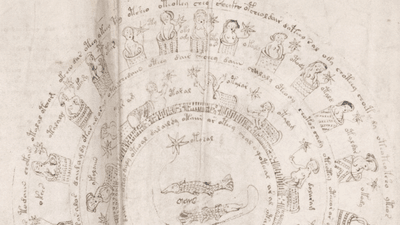


New research on the Voynich manuscript suggests we may have been "reading" the indecipherable document out of sequence for over a century, and that it may not have originally been a codex at all.
If you're looking for a mysterious undeciphered text to sink some time into, accept no substitute for the Voynich manuscript; the mysterious document that, despite the best efforts of many researchers, refuses to give up its secrets.
In 1912, a Polish book dealer named Wilfrid Voynich discovered the manuscript, supposedly in a chest inside an ancient church in southern Europe. That makes it sound a lot more Elder Scrolls or Indiana Jones than it probably was, and it would be fairer to say that he purchased it from a Jesuit collection (though it's not certain exactly where that collection was housed).
The manuscript itself, an illustrated codex, is pretty bizarre, containing illustrations of unidentifiable plants, odd animals, dragons, castles, and puzzling astrological symbols. Then there is the language within it, one that looks like it could be a natural language, and even appears to follows laws of natural languages according to researchers, but is completely indecipherable to this day.
"While the text is undeciphered, the manuscript’s many illustrations hint at its content," the Yale Library explains.
"Six distinct sections present plant specimens; astronomical and astrological drawings; balneological drawings depicting baths and bathing; cosmological medallions; pharmaceutical drawings of herbs and roots; and unillustrated text, possibly recipes, with star-like flowers marking each entry."
There are people who think that the codex is a hoax, and given how fantastical it looks, honestly who can blame them. However, there are reasons to believe it is, at the very least, a very old hoax.
"Research on the Voynich manuscript has revealed some clues about its origins," Keagan Brewer, Research Fellow at Macquarie University in Australia, explains in a piece for The Conversation.
"Carbon dating provides a 95 percent probability the skins used to make the manuscript come from animals that died between 1404 and 1438. However, its earliest securely known owner was an associate of Holy Roman Emperor Rudolf II, who lived from 1552 to 1612, which leaves more than a century of ownership missing."
"Certain illustrations (the zodiac symbols, a crown design and a particular shape of castle wall called a swallowtail merlon) indicate the manuscript was made in the southern Germanic or northern Italian cultural areas."
Beyond that, we don't know a whole lot about it. And now, it turns out, we may have gotten the pages in the incorrect order, perhaps making an incredibly difficult task of figuring out what's going on with it even more difficult.
Researchers Colin Layfield and Lisa Fagin Davis analyzed the manuscript using Latent Semantic Analysis (LSA), a type of statistical analysis that can be applied to large texts, for example to find where several words have similar meanings. The team used this not to attempt to decipher the meanings of the words, but to look for evidence of the original structure and order of the document.
Through comparisons with known texts such as the Aberdeen Bestiary and the Speculum Humanae Salvationis we have found strong evidence that the Voynich manuscript is not meant to be bound in quires at all (as is the norm)," the team explains in their peer-reviewed paper, "but, instead, was originally a collection of individual bifolia meant to be read in sequence (called “singulions”)".
The team cites some fairly convincing evidence suggestive that the pages have been bound out of order. Some pages have illustrations that cross the center of the book and emerge on the next page. On others, they appear intended to cross the central "gutter" of the book, and continue on the opposite page, but the next page appears later in the manuscript.
The team's LSA analysis and comparison with other texts support this idea, as well as the possibility the pages were written by several different humans. Though by no means a mainstream idea, people have attempted to attribute it to, for example, Leonardo da Vinci.
“There are a lot of people who wanted the Voynich to have been created by one mad genius working in their attic in medieval London or wherever,” Davis told The Guardian.
“In fact, the evidence suggests we’re talking about a more communal object, perhaps a set of booklets through which information was passed down from one generation to the next – the ‘lone genius’ idea is kind of out of the door.”
Given the illustrations in the book, which include drawings resembling the female reproductive system, and potential herbal knowledge or folk tales, Davis suggested that it could be a sort of book of women's folk knowledge, which had been intended to pass down.
So, when did this mix-up happen? The team cites earlier research that found that the work had only been bound once, at some point in the late Gothic period (ca. 1400-1500). While the original binders may have caused everybody an extra headache, with very few medieval documents preserved as singulions, they can probably be thanked for its survival.
The study is published in Digital Medievalist.