Humans
 PUBLISHED


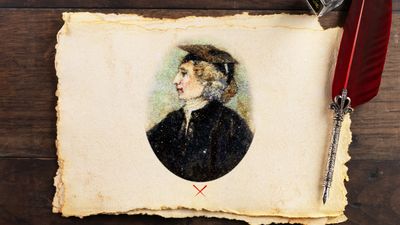


Who was the first person to use an “X” to denote a kiss at the end of a letter? For a long time, people have assumed it was the Gilbert White, the famous 18th century naturalist – but is this the case? New research pours cold water on the origin myth associated with this heartwarming symbol.
It is not clear when this idea first gained traction, but the Oxford English Dictionary’s earliest citation for “X” to signify a kiss associated it with White. Since then, the idea has become received wisdom, being repeated in various places. But is it true? Well, not according to a new study.
Careful work
Before diving into the story of the kiss, it’s probably worth introducing the man behind all the fuss. The Reverend Gilbert White (1720-1793) was a pioneering English naturalist who significantly impacted how we view the natural world. He spent most of his life living in Selborne, a small village in Hampshire, UK. White was not a professional naturalist in the modern sense. Like many of his contemporaries, he was a clergyman who was innately curious about the natural world and its history.
His contributions all come down to his patient observation of nature, especially of things many of his contemporaries (and we today) would dismiss as mundane. For instance, he was fascinated by the migratory movement of birds, the times of the year when flowers appeared, and even the hibernation routines of Timothy, his pet tortoise. While many naturalists were interested in the morphology of species, White wanted to explore their behavior.
This careful consideration of ordinary things was not just for him; White took every opportunity to share his notes and observations with others who were interested in nature. Some of his correspondents included Thomas Pennant, who wrote British Zoology in 1766, and Daines Barrington, the then Vice President of the Royal Society. He also corresponded with other notable luminaries, such as the botanist and explorer Joseph Banks, and Daniel Solander, a disciple of Carl Linnaeus.
The man behind the kiss?
It is the topic of White’s many correspondences that is mistakenly bound up with the story behind the “X” for kisses. The elements of these letters that have gained this association are a series of “xxxxxxx” in a letter to Catherine Battie he wrote in 1763, and an “X” like symbol that appears at the end of many correspondences.
However, this does not seem to be the case. Previous work has already debunked the former example. Stephen Goranson, a researcher at Duke University, has argued that these X’s may actually be crosses that denote blessings, rather than kisses. The full valediction reads: “I am, with many a xxxxxxx and many a Pater noster and Ave Maria, Gil White.”
As Goranson noted, according to History Facts, the reference to religious phrases such as “Pater noster” and “Ave Maria” would suggest an association with a blessing. It is likely, Goranson argues, that the kisses gradually emerged from the use of crosses as blessings as time went on, resulting in their full romantic association only in the late 19th century.
Moreover, White included these X’s in many letters to correspondents with whom he was professionally, rather than intimately, connected. While these letters may sometimes move beyond strictly naturalist interests, they contain no signs that suggest White would be sending them kisses as a sign-off.
So much for the multiple X’s in this first case – what about the second examples? These X-like symbols in his other letters are still debated by academic and amateur researchers. But they are no more kisses than the blessings mentioned above, according to a new paper by Stephanie Holt, UK Biodiversity Training Manager at the Natural History Museum, London and DPhil student at the University of Oxford.
“Some commentators have speculated that the ‘X’ is a religious cross, reflecting White’s piety. In the medieval period a single ‘X’ was inscribed at the end of documents as a crux decussata, Saltire or St Andrew’s Cross; these themselves may have origins in the X for a kiss at the end of a letter, as they are known to have been kissed as a symbol of faith,” Holt writes.
“But there is a more mundane explanation. An examination of White’s handwriting across multiple letters, reveals that the same symbol appears repeatedly within the body of the text, not only at the end.”
Rather than being kisses or even crosses, Holt argues, these marks are actually a once common shorthand “&c” – essentially an abbreviation for et cetera. In White’s handwriting, this symbol, when written quickly or at a slant, takes on the appearance of an “X”.
“In valedictions such as ‘I am your humble servant, &c &c,’ or simply ‘I am, &c &c’ White was following convention, not expressing overt affection. In addition, White used ‘X’s elsewhere in his correspondence to mark letter corrections, edits, and redactions, as well as using the ampersand symbol to denote ‘and’,” Holt explained.
Ultimately, she concludes, the “mystery of the ‘X’ is thus a palaeographic misunderstanding, rather than an epistolary innovation denoting a kiss, which was not widely used until the late nineteenth century.”
The paper is published in Archives of Natural History.