Humans
 PUBLISHED


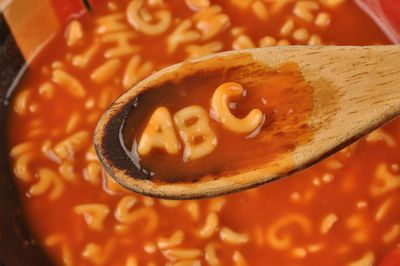


Long ago, but not that long ago, the English alphabet had 27 letters, rather than the current 26. In fact, it even had a starring role in the singsong nursery rhymes used to teach children their ABCs.
That symbol is &, also known as the ampersand, meaning the word “and.” It’s still widely used today, although mostly as a stylistic choice to make word combinations look sleek or distinctive – like Ben & Jerry’s, Dungeons & Dragons, Simon & Garfunkel, and so on.
The story starts, as many things do, with the Romans and the Latin language. The Latin word for “and” is “et,” but these two letters would frequently become squished together when scribes were scrawling texts in a rush. The “e” and “t” eventually became joined into their own ligature that looked something like this: &.
Some of the oldest English alphabets ever documented feature the ampersand symbol, typically at the end of the alphabet after Z. A very early English alphabet described by the English monk Byrhtferth over 1,000 years ago contained 23 original Latin letters, plus several others, including &.
A bunch of Old English letters have faded into obscurity over the centuries and no longer feature in modern English alphabets, but the ampersand stuck around until the 1800s. So instead of finishing with “…X, Y, Z,” 19th-century teachers and schoolchildren would continue with “&”.
However, they would pronounce it like “and, per se, and.” This is because "per se" means “by itself” in Latin. At the time, the phrase was added in instances when a letter could also represent a whole word, such as "A" or "I". For example, people would say “A, which by itself is the word, A.” Likewise, “and per se and” basically meant: “and, which by itself is the word, and.” Over the years, this became mashed into the word we use for the symbol today, the ampersand.
It’s unclear why or when exactly the ampersand was dropped from the English alphabet. However, one unconfirmed theory is that its demise is linked to the modern “ABC Song” taught to kids, set to the tune of Twinkle, Twinkle, Little Star. This version of the song, which leaves out the ampersand, was copyrighted in 1835 by an American music publisher. Is it a coincidence that this is also the era when & fell out of favor?