Nature
 PUBLISHED
 7
7



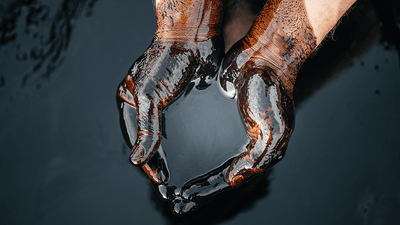


At some point in your life, you have likely been told that oil is made from dinosaurs, as if a stegosaurus plopped down dead, sat there in the ground for millions of years and turned into juice that can power your Hyundai. While an enjoyable idea, it is a misconception, one that probably has its roots in the 1933 Century of Progress World's Fair in Chicago.
“For some strange reason, the idea that oil comes from dinosaurs has stuck with many people," geologist Reidar Müller at the University of Oslo explained to Science Norway. "But oil comes from trillions of tiny algae and plankton."
What actually happens is far less T. Rex from Jurassic Park, and a lot more Plankton from Spongebob Squarepants. Tens to hundreds of millions of years ago, vast numbers of algae and plankton lived out their short lives, getting their energy from the Sun or else feeding on smaller creatures. As they died and sank to the bottom of the ocean, these tiny organisms slowly built up into layers, which can be miles thick.
These layers slowly got buried underneath more and more sediment, compressing them into a type of sedimentary rock known as "source rocks". These rocks, under the right amount of heat and pressure, and in environments with very little oxygen, essentially get crock-potted into the black goo we humans lust for.
So clearly oil is created in marine environments, rather than where terrestrial dinosaurs roamed. While the occasional marine reptile, or maybe a Triceratops making an ill-advised attempt at swimming, might end up on the ocean floor, they are going to be ine the extreme minority. Just because strawberries can contain mites, for example, doesn't mean they are made of mites.
Also, larger creatures that sink to the ocean floor tend to get devoured quite quickly, as anyone familiar with whalefall will know, preventing them from one day being burned in vehicles.
So, where did the idea that oil is made of dinosaurs come from? Did scientists ever believe it to be true?
The short answer is no. When we first encountered oil, humans didn't really know what it was. But we thought it may be some sort of mineral, with petroleum meaning "rock oil" in Latin. Russian scientist Mikhail Lomonosov was the first to propose that oil is made of organic material that has been compressed and heated over time, back in 1763. There have been no serious suggestions that oil was made of dinosaurs, before or since.
The reason for the confusion may partly be down to the name fossil fuels, with many people associating the word "fossil" with "big old dinosaur remains". But the oil company Sinclair is likely more to blame for the myth, due to their exhibit at the Century of Progress World's Fair in Chicago in 1933, and their advertising campaign utilizing dinosaurs as a mascot.
"Sinclair's advertising writers first had the idea to use dinosaurs in Sinclair marketing back in 1930. They were promoting lubricants refined from crude oil believed to have formed when dinosaurs roamed the earth, Sinclair's website explains. "The original campaign included a dozen different dinosaurs, but it was the gentle giant, the Apatosaurus, that captured the hearts of Americans."
While it's true that oil (around 54 percent of it, to be precise) was created around the time as the dinosaurs, the iPhone came out around the same time a certain Dreamworks feature came out, and you don't see it advertised with the face of Shrek. Put a dinosaur on the packaging, and people will assume it's an ingredient, like pictures of oranges on a carton of juice.
The association of dinosaurs with the brand, and ultimately with oil, was consolidated at the World's Fair, where Sinclair sponsored a display of nine full-sized dinosaurs seen by around 16 million attendants to the exhibition. The dinosaurs, and particularly the apatosaurus that would become the firm's logo, were appealing to the public, and the company started to display dinosaurs at Macy's Thanksgiving Day parade annually from 1963.
"Their crafty marketing campaign, I think, sealed the link between dinosaurs and oil in the public imagination, drilling the faulty connection into the minds of nearly everyone," American palaeontologist and geologist Kenneth Lacovara explains in a piece for Powell's. "The bad wiring goes something like this: Oil is fossil fuel, and most of it comes from the age of the dinosaurs. Fossils equals dinosaurs, therefore dinosaurs equals oil."
So it was advertising, not science usurped by more science, that appears to have led to the association in the public's mind between dinosaurs and oil.