Space and Physics
 PUBLISHED


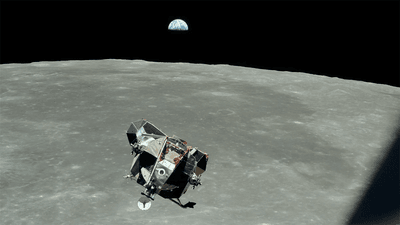


When Apollo 11 astronauts Neil Armstrong, Buzz Aldrin, and Michael Collins returned from their mission to the Moon, they brought with them tales of what it was like to be the first humans standing on the surface of another world, tales of what it was like to be kind of near that (sorry, Michael), and a very unusual meal for some cockroaches.
While it may seem a strange idea now given what we know about the lifelessness of the lunar surface, at the time of Apollo 11 there were a lot of unknowns. Upon their return, for example, the crew of Apollo 11 spent 21 days in quarantine just in case they had returned from our satellite carrying dangerous microorganisms.
They of course were not carrying anything dangerous with them upon their return, but they had bagged up an impressive amount of space rock for study back on Earth. The first humans on the Moon brought back around 21.6 kilograms (47.6 pounds) of it back with them, including 50 rocks and samples of the lunar soil from the surface and just below.
Moon samples that aren't stolen in a wild heist are put to a number of scientific uses. The top priority here was to see if they contained organic compounds, or signs of life. But with that much rock to go around, why not feed a little to cockroaches, shrimp, and wax moths?
Marion Brooks, an associate professor in the University of Minnesota's Department of Entomology, was one of the scientists to get their hands on those first Moon samples, as a special consultant to NASA's resident entomologist. Her project was to study the effects of the lunar soil on these animals, as well as to oysters, house flies, small fish called mummichogs, and guppies, all chosen because they were easy to get ahold of, and easy to care for.
Under Brooks' supervision, the idea was simply for NASA to take animals and make them eat ground-up Moon soil. One group of animals would consume sterilized Moon dust ground up into their food or water, another unsterilized Moon dust, and one unlucky control group didn't get to eat the Moon at all. As well as this, there was a condition where some of the animals did not eat the Moon dust, but did have to crawl through dust left at the bottom of their enclosures.
So, was there any effect? In short, no. The highest mortality rate was suffered by a group of small fish in the control group, who died after disinfectant was spilled, and they happened to be the closest to the released fumes. Brooks, who had suspected there would be no organisms on the Moon, was nevertheless surprised to find that the samples did no damage to the cockroaches' stomachs or cuticles, despite consuming and crawling around in the lunar soil.
"We thought when the moon sample was ground up that there would be sharp, jagged edges," she said at the time. "But there were no signs of abrasion or scratches."
While the experiment may seem a little unusual now, that's because we know the Moon is lifeless. Back then, though scientists largely suspected that to be the case, they had to do the work to show this.
"We had to prove that we weren't going to contaminate not only human beings, but we weren't going to contaminate fish and birds and animals and plants and you name it," Charles Berry, head of medical operations during the Apollo missions, explained in a NASA oral history project in 1999. "Any of the Earth's biosphere, we had to prove we weren't going to affect it. So we had to develop an amazing program that was carried off really for three flights' worth. A lot of trouble."
Thanks to NASA scientists, astronauts, and indeed cockroaches, we now know that the lunar soil is lifeless, and (relatively) harmless to life on Earth.
An earlier version of this article was published in June 2022.