


 Nature
 PUBLISHED


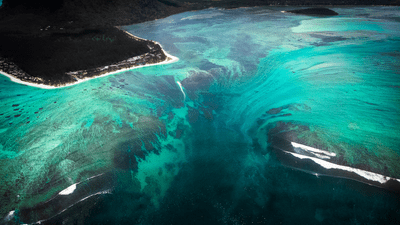


An underwater waterfall might sound like a new breed of disaster movie, but such a sight can be found in modern-day Mauritius. The unique formation is made possible by the fact that this East African country sits atop a submarine plateau known as the Mascarene Plateau.
Unlike continents whose land mass gradually sinks into the ocean with continental shelves that sit far offshore, land masses on top of submarine plateaus like Mascarene can drop off quite suddenly into the deep ocean. The geological quirk means that were you to go for a swim you might quickly find yourself bobbing above waters that stretch down for thousands of meters.
The extreme and uneven lay of the land in this region is the result of volcanic activity which gave rise to Mauritius around 8 million years ago. Being a volcanic hotspot, the plateau saw enormous underwater eruptions that spewed magma through the continental crust of Mauritia, and it was this magma that solidified to form the Mascarene Islands.
Interestingly, evidence of Mauritius’s birth through Mauritia can be found in the form of minerals in its white sandy beaches. Known as zircons, grains of the super-tough material (which is associated with continental crust) were found to be up to 2 billion years old.
While some shallower marine habitats exist around Mauritius, where the underwater “waterfall” sits is at one of the points where the seabed suddenly plummets. Its waterfall-like appearance is less to do with the movement of water, and more related to the sinking of sand.
Mauritius is rich in sand and while in some parts it near enough stays put, at the site of the underwater waterfall it is spilling into the horseshoe drop-off. It’s an example of erosion that sees the influence of ocean currents sweep the sands of the shallow shelf and into the deep ocean and is why volcanic islands don’t last forever.
The island is just a few million years old but has already stopped growing and will likely recede back into the water in a few more million years to come. As the island is slowly chipped away by ocean currents, it will get smaller and smaller, though whether humankind will survive long enough to see the effects of that is very much up for debate.
So, while the underwater waterfall looks like a dramatic water feature that could well pull you and your inflatable flamingo floaty under, it actually would have little impact on your swimming beyond perhaps being a bit spooky to drift over.
The same could not be said were you to direct your floaty into the mouth of Thor’s Well…

 1
1