Nature
 PUBLISHED
 4
4


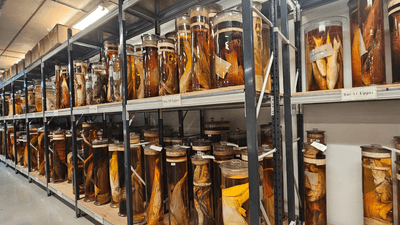


From 1831 to 1836 Charles Darwin went on something of an animal collecting tour. Many of the creatures he encountered wound up in jars, specimens that – remarkably – are still intact today.
They’ve survived for such a long time thanks to Darwin’s secret recipe for pickling preserved specimens. Only problem was, for a long time we couldn't find out exactly what it was.
One does not simply pop open a jar that’s been sealed for 200 years. While it's certainly possible to remove wet specimens, doing so risks evaporation, contamination, and environmental damage. Not something you want to risk when you're the custodian of a piece of natural history.
We do need to know what old specimens are preserved in, however, as it’s critical information for monitoring a specimen’s condition over time (you don't want to see what happens to a ~200-year-old specimen when the pickling potion loses its potency).
To safely explore the mystery of Darwin’s special recipe, scientists at the Natural History Museum, London, tried a new approach. They looked at 46 wet specimens, including some of Darwin’s, using a portable laser spectroscopy method called Spatially Offset Raman Spectroscopy (SORS).
The technique can peer through glass to identify a fluid's chemical composition by shining a laser into it. When the light of that laser is reflected back, changes in its wavelength can give researchers a clue as to a fluid’s chemical components.
It revealed that mammals and reptiles in Darwin’s era were typically fixed in formalin and then stored in ethanol, a popular alcohol for preventing decay. Invertebrates were more varied, being kept in formalin, buffered solutions, and mixtures containing glycerol.
The novel approach for specimen examination was found to be pretty reliable, correctly identifying solutions’ chemical composition in 80 percent of cases. It could even reveal what kind of glass or plastic was used to contain the specimen. A critical leap for museum collections and the antique specimens they contain.
“As part of NHM Unlocked, here at the Museum we can analyse jars containing specimens without opening and disturbing their integrity,” said Wren Montgomery, research technician at the Natural History Museum, in a release.
“This work is the next step in demonstrating the Museum’s commitment to transforming the study of natural history. Analysing the storage conditions of precious specimens, and understanding the fluid in which they are kept, could have huge implications for how we care for collections and preserve them for future research for years to come.”
The study is published in ACS Omega.