Space and Physics
 PUBLISHED
 3
3


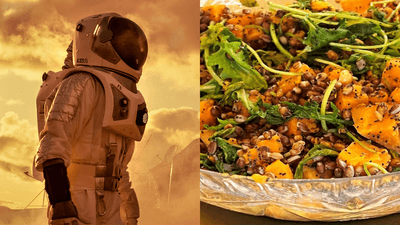


With space agencies’ sights set on increasingly long missions, beyond building resilient spacecraft, they’re also having to figure out the best way to keep astronauts well-fed. Researchers now think they’ve found the answer, and we’ve got bad news for any meat-loving space travelers: it’s a vegetarian salad.
Astronauts have a unique set of needs when it comes to food; they burn more calories in space, so need something that packs a punch energy-wise. The effect of microgravity on their bones also means they require more calcium than those of us on Earth.
With this knowledge in hand, a multi-institution group of researchers also had to account for what could be grown on a spacecraft – after all, there aren’t any McDonald’s near Mars. Although astronauts have been growing food in space (and losing it), the team aimed to establish what a nutritionally optimized and palatable meal using those crops could look like.
They assessed 10 different space meals, considering up to 102 different crops, based on two main factors. The first was how well the particular combination of foods could meet a male astronaut's daily nutritional needs while also minimizing the water required to grow the meal’s ingredients. The second was sustainability – how much fertilizer, time, and space was needed for crop growth? Could inedible parts of the food be recycled?
Although the team tested both vegetarian and omnivorous meals, the winner of this very niche edition of Masterchef was a veggie combination, consisting of soybeans, poppy seeds, barley, kale, peanuts, sweet potato, and/or sunflower seeds. It doesn’t quite provide all the micronutrients an astronaut needs – it’s a difficult ask, after all – but the researchers suggest a supplement could make up for that.
While sustainability and nutrition are great, it’s also important to consider the taste of a space meal – if an astronaut is going to be eating it regularly for several years, they probably would rather it didn’t taste like garbage. So, the researchers turned the combination of foods into a salad and gave it to a focus group of two men and two women here on Earth to try.
The volunteer space salad critics gave some pretty good reviews; one even compared it to a gourmet salad, whilst another said that they “wouldn’t mind eating this all week as an astronaut”. One of their fellow study participants needed a second bowl to be convinced that they liked it – either that or they were taking advantage of the free food.
Despite the positive feedback, the researchers believe there’s still room for improvement. In their conclusion, they describe the importance of future research considering different ages, sexes, and health levels in developing space meals, as well as the role lab-grown meat or nutrients from fortified “space drinks” could play.
The study is published in ACS Food Science & Technology.