Space and Physics
 PUBLISHED
 24
24




Humanity has successfully landed probes on Mars and Venus, two of the four rocky planets of the Solar System. While a mission to Mercury, being so close to the Sun and nearly as hot as Venus, is a tricky goal for future operations, if it has a rocky surface, human scientists will find a way to land there.
Not all of the planets of the Solar System are suitable for a soft landing, however. Gas giants Jupiter and Saturn are primarily composed of hydrogen and helium. Trying to stand on them would not end well. The closest we have come is sending probes crashing into the gas giants as the final stages of their missions, in Jupiter's case, to protect the moon Europa from potentially becoming contaminated.
"Its entry point into the giant planet’s atmosphere was about 1/4 degree south of Jupiter's equator. If there were observers floating along at the cloud tops, they would see Galileo streaming in from a point about 22 degrees above the local horizon," NASA explains. "Streaming in could also be described as screaming in, as the speed of the craft relative to those observers would be 48.2 kilometers per second (nearly 108,000 miles per hour). That is the equivalent of traveling from Los Angeles to New York City in 82 seconds."
The probe sent back data for around an hour before it died, long before it reached any kind of surface. While we believe the planet has a solid core, that isn't confirmed, and with the temperature and pressure being incredibly high, it would not be like walking on a rocky planet once you got there.
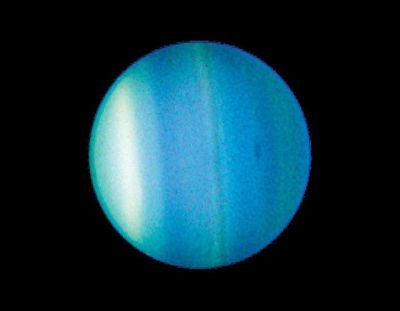
So what about the ice giants, Neptune and Uranus? Would it be possible to stand on Uranus? Like with the gas giants, the ice giants are primarily composed of hydrogen and helium. However, they also contain other elements, complicating the picture.
"It’s hard to tell for certain because Uranus and Neptune are shrouded in a shell of hydrogen and helium, but astronomers think the water, ammonia and methane in their mantles are in the form of fluids under very high pressure – so not really ices," Dr Carole Haswell, Senior Lecturer in the Department of Physics and Astronomy at the Open University explains.
"Uranus and Neptune are actually called ice giants because scientists think the water, ammonia, and methane were all ices when the planets were formed."
Neither planet has a solid surface to land on. The outer layers that we see are swirling gases. But sink down far enough into the planets – which you would, being more dense than gas, no offence – and you would eventually meet a rocky core.
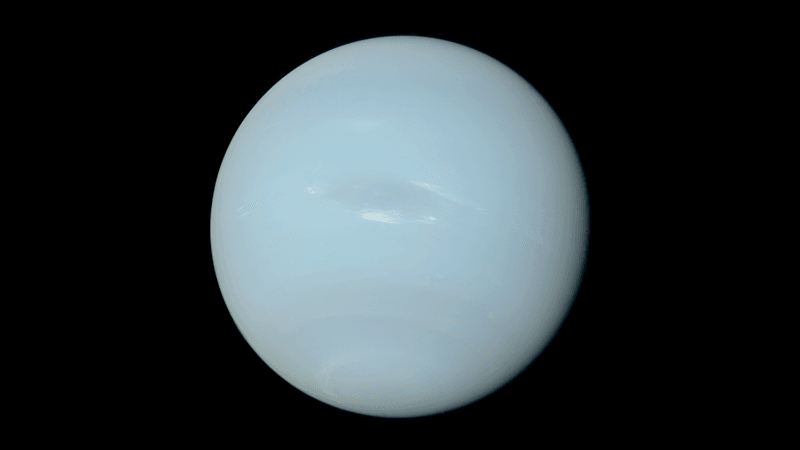
"Neptune does not have a solid surface," NASA explains of the ice giant. Its atmosphere (made up mostly of hydrogen, helium, and methane) extends to great depths, gradually merging into water and other melted ices over a heavier, solid core with about the same mass as Earth."
The situation on Uranus is thought to be the same.
"As an ice giant, Uranus doesn’t have a true surface. The planet is mostly swirling fluids," NASA writes. "While a spacecraft would have nowhere to land on Uranus, it wouldn’t be able to fly through its atmosphere unscathed either. The extreme pressures and temperatures would destroy a metal spacecraft."
In short, if you tried to land on Uranus or Neptune, you would eventually meet a rocky surface. But by that point, you would be crushed into a human soup. Of course, space agencies are working on sending probes there anyway, to better understand these planets.
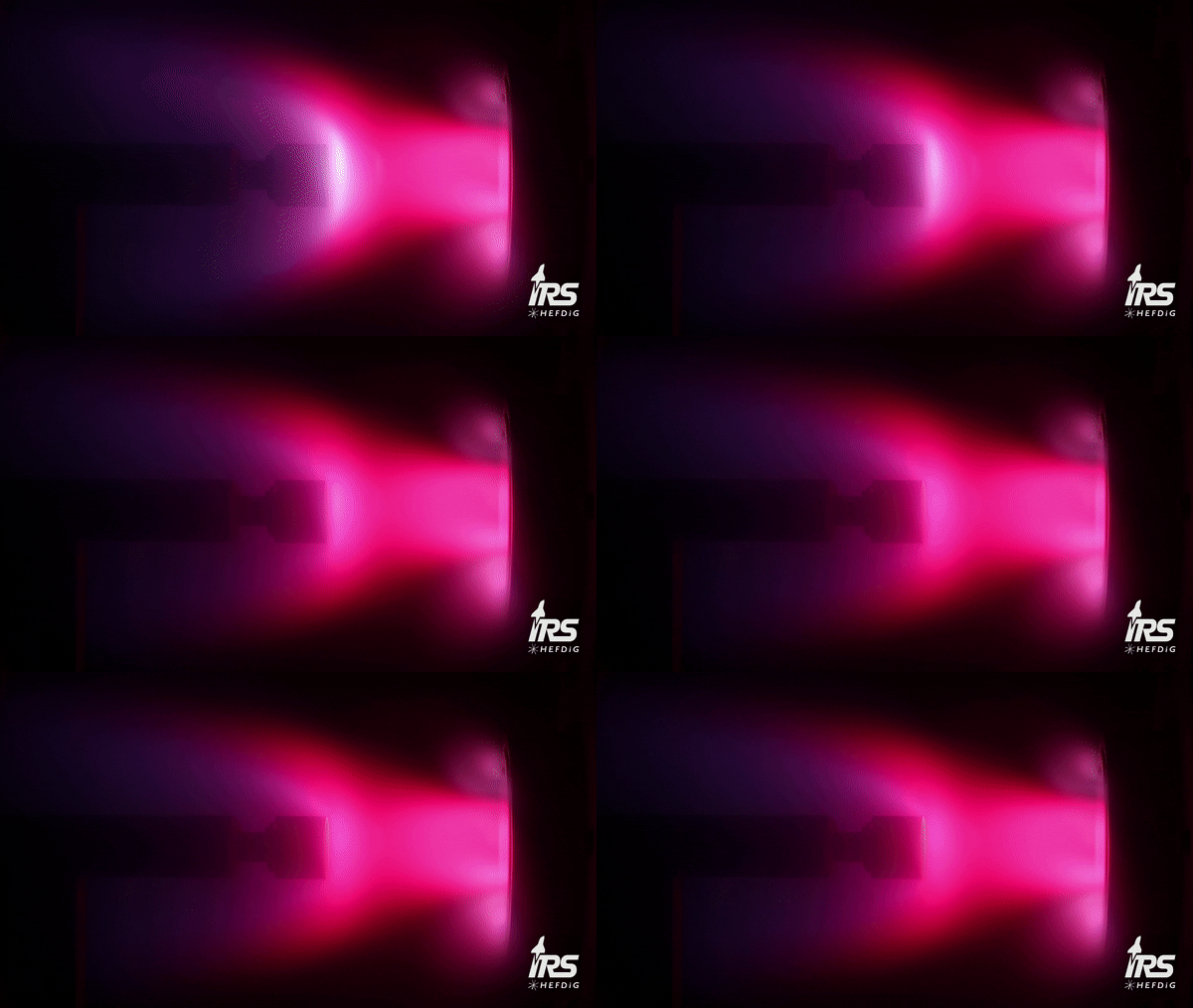
“The challenge is that any probe would be subject to high pressures and temperatures, and therefore would require a high-performance thermal protection system to endure its atmospheric entry for a useful amount of time,” the European Space Agency’s Louis Walpot said in a 2023 statement, after attempting to simulate such a probe.
“To begin designing such a system, we need first to adapt current European testing facilities in order to reproduce the atmospheric compositions and velocities involved.”
More work is required, not least in designing a mission that would approach the ice giants at the correct velocity, but fingers crossed, we will one day we will be able to probe Uranus.