Space and Physics
 PUBLISHED


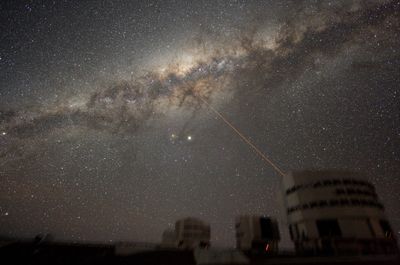


We have known for a while that Earth is not the center of the universe. It is also in no special place in the Milky Way, orbiting in the Orion Arm about halfway between the center of our galaxy and its edge. This position has a peculiar effect on our ability to study the universe in every direction: the Milky Way itself blocks a substantial region of the sky. Meet the Zone of Avoidance.
The Zone of Avoidance is an extremely fascinating area of the sky. It has been known about for around a century and a half, even though at first it was referred to as the Zone of Few Nebulae – until the 1920s, astronomers didn’t know that other galaxies existed and "nebulae" was the catch-all term. About 20 percent of the entire extragalactic sky is obstructed by the stars and interstellar dust that make up the plane of the Milky Way.
The fact that we can’t study the region is already motivation enough to find workarounds. That is compounded by the fact that one of the most mysterious features in our local universe appears to sit right within it. We are talking about the Great Attractor. This is the center of a major supercluster of galaxies that is pulling the Milky Way and a bunch of other nearby galaxies and galaxy clusters towards it. And it is not the only supercluster located in the Zone of Avoidance.
If the Zone blocks one-fifth of the extragalactic sky at visible wavelengths, how can we tell that there’s something behind it? Well, fortunately we do not only rely on visible light to do astronomy. Longer wavelengths (radio waves, microwaves, and infrared) can be used to see farther into the Zone of Avoidance. So can X-rays.
From the first infrared observations, astronomers have been able to find stuff that we have been missing. Back in 1968, astronomer Paolo Maffei discovered two large galaxies that are relatively close to our own. Maffei 1 is a large elliptical galaxy 9.8 million light-years away, and Maffei 2 is a spiral galaxy 10 million light-years away. If Maffei 1 were not in the Zone of Avoidance, it would be one of the brightest known galaxies in the sky.
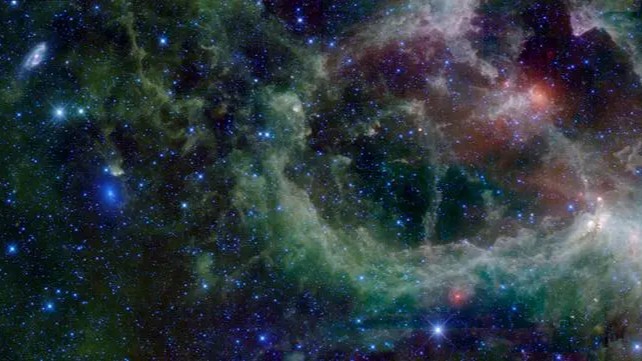
As mentioned, there is also the Great Attractor, which is the basin for the proposed Laniakea Supercluster, a structure that spans about 500 million light-years across and is about 150 to 250 million light-years from us. And even the supercluster is moving, flowing towards the Shapley Attractor that lies behind.
And there is the Vela Supercluster, one of the largest structures in the universe, located about 870 million light-years away and weighing about 1,000 times our own Milky Way. And there are smaller but even more distant clusters.
It seems like there's a lot of important stuff going on in an area of the sky we have difficulties probing. It is no grand conspiracy, just poor timing for our species. Our galaxy rotates, so if we were a few dozen million years in the past or in the future, we’d be able to see these intriguing features with a lot more ease.