Nature
 PUBLISHED


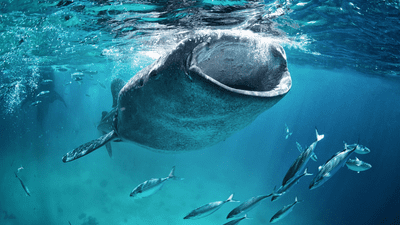


Whale sharks could serve as inspiration for young children who are hesitant to broaden their horizons at the dinner table, as being omnivorous has clearly worked for this species in growing to be big and strong. While it’s long been known that the biggest fish in the sea gorges on krill, new research has shown that they can benefit from eating plant material, too.
The findings, reported in the journal Ecology, confirm that the whale shark (Rhincodon typus) is the largest omnivore in the world.
“This causes us to rethink everything we thought we knew about what whale sharks eat,” said Australian Institute of Marine Science fish biologist Dr Mark Meekan in a statement. “And, in fact, what they’re doing out in the open ocean.”
The discovery kicks the Kodiak bear off the top spot for World’s Biggest Omnivore, as despite being the planet's biggest bears (weighing up to 680 kilograms/1,500 pounds) they’ve got nothing on 10-meter-long whale sharks that can weigh 19,000 kg (42,000 pounds).

As filter feeders, whale sharks have been observed at Western Australia’s Ningaloo Reef scooping up bucket loads of krill. However, a comparison of possible food samples in the environment to their tissues showed they follow the trend of the world’s largest animals in enjoying plants, too.
“On land, all the biggest animals have always been herbivores,” said Meekan.
“In the sea we always thought the animals that have gotten really big, like whales and whale sharks, were feeding one step up the food chain on shrimp-like animals and small fishes. Turns out that maybe the system of evolution on land and in the water isn’t that different after all.”
It seems that a local seaweed, Sargassum, has become incorporated into whale sharks’ diets over time. This means when the whale sharks make their annual migration to Western Australia, they’re dining on a buffet of not just krill but algae too.
Using tissue samples from whale sharks and analyzing their content meant that the researchers were able to rule out the possibility that seaweed was getting scooped up accidentally but not actually digested. The presence of certain isotopes demonstrates that whale sharks are able to use plant matter as a means of growing, and that actually, krill was less well metabolized than expected.
“It’s very strange because in their tissue they don’t have a fatty acid or stable isotope signature of a krill-feeding animal,” biological oceanographer Dr Patti Virtue, from the University of Tasmania’s Institute for Marine and Antarctic Studies, added. “[Their] poo did show that they were eating krill, but they're not metabolising much of it.”