Space and Physics
 PUBLISHED



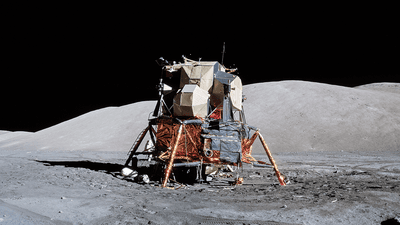


A new paper describes how we could use the Moon, our natural satellite, as a gigantic, 73-quintillion-tonne gravitational wave (GW) detector. According to the team, the Moon could even act as an amplifier for the seismic signals caused when gravitational waves pass through it.
First, the basics, so we are all on the same page. Gravitational waves are ripples in spacetime that were first predicted by Albert Einstein in 1916, a consequence of his general theory of relativity.
"In this theory, concentrations of mass (or energy) warp space-time, and changes in the shape or position of such objects cause a distortion that propagates through the Universe at the speed of light (i.e., a gravitational wave)," writes Nobel Prizewinner Barry C. Barish at the California Institute of Technology, in a paper.
Detection of such waves isn't so easy, and it would take until 2015 until they were first detected and confirmed by the Laser Interferometer Gravitational-Wave Observatory (LIGO).
Gravitational wave detectors like LIGO, though they need to be pretty sizeable to perform the task, are fairly simple to get your head around.
"All you need to build a gravitational-wave interferometer is two light beams, travelling between pairs of mirrors down pipes running in different directions, say north and west," Professor Ed Daw at the University of Sheffield explains in an article for The Conversation.
"The effect of a passing gravitational wave should stretch space in one direction and shrink it in the direction that is at right angles."
"On Earth, that would cause the mirrors to swing by tiny amounts, so that the distance between one pair of mirrors gets smaller, while the other gets larger. The swinging is actually the mirrors responding to the stretching and compression of space-time, which is just amazing."
So, how do we turn the Moon into one of these beauties? The idea is not to build a detector on the Moon, but to use the Moon as a detector itself (with a little help from seismology).
As gravitational waves pass through the Moon, the Moon itself is expected to be stretched and squeezed ever so slightly by them. The basic idea is to catch this stretching and squeezing by measuring the resulting seismic vibrations as they reach a deployed seismometer.
“The gravitational wave would come [...] from very far away, like the early universe. [I]t would come to the Moon and it would cause it to vibrate like a bell," Jan Harms of the Gran Sasso Science Institute explained to IFLScience.
"Then essentially you can put sensors on the surface of the Moon to measure its deformations or vibrations."
This idea is actually not so new and dates way back to the Apollo era. In fact, NASA's Apollo 17 mission deployed the Lunar Surface Gravimeter Experiment on the surface of the Moon with the aim of detecting gravity waves in this way.
Unfortunately, it didn't function well when it was deployed, and no gravitational waves were detected passing through the Moon.
Taking account of lumps and bumps
In a new paper, researchers from the Chinese Academy of Sciences and Peking University attempted to better model how such a detector could work.
While previous attempts had used idealized models of the Moon, without its trademark craters and rugged surface, this team created a new and more realistic model of our natural satellite.
"Theoretical models suggest that the Moon could act as a resonant detector, but the unknown influence of its rugged surface and heterogeneous interior poses a challenge to the accurate modeling of its response," the team writes in the paper.
"Here, we address this long-standing uncertainty by constructing the first high-resolution, two-dimensional model of the lunar GW response, more realistic than previous ones."
Using the model, the team was able to identify where gravitational wave signals could most easily be detected, with the goal of finding a place to park China's Chang'e-7 mission, with the first broadband lunar seismometer in tow.
During this process, the team found there were certain areas that could amplify signals quite nicely and for frequencies of gravitational waves that are more difficult or impossible to probe with our current Earth-based detectors.
"On average, the seismic signal can be amplified by 10% in thick-crust regions. In some narrow frequency ranges, the amplification can even exceed one order of magnitude," the team explains.
"Regions characterized by thicker crust, particularly the farside highlands, consistently exhibit an amplification of the GW signal, therefore offer better opportunities for GW detection," they added.
While more work will be needed in designing seismometers, as well as honing down potential landing sites, it is plausible that humanity could begin detection of gravitational waves using the whole freaking moon.
"We found that the moon may ring louder in response to gravitational waves than people previously thought," Xian Chen, astrophysics professor at Peking University, added to Phys.org.
"In the past, the missing ingredient was the variation in lunar crust thickness. We think our work is important for deciding deployment sites for future lunar seismometers. And such better-informed decisions would greatly enhance the science payback of lunar seismology projects."
The study is published in Physical Review Letters.

 1
1