Nature
 PUBLISHED
 1
1


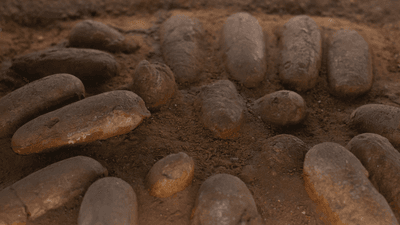


Dinosaur eggs make great fossils. They can be hundreds of millions of years old, contain near-complete embryos, and even be stuffed full of sparkly crystals. They’re rock-hard by the time they make it into the fossil record, but when laid, were dinosaur eggs hard or soft?
A 2023 study weighed in on the debate as it investigated three adult skeletons found alongside five clutches of embryo-containing eggs. The discovery marked a new-to-science species of sauropodomorph named Qianlong shouhu, roughly translating to “guarding dragon”. A hat tip to the fact that this could represent the earliest known fossil evidence of adult dinosaurs by their nests in a kind of “colonial nesting” we see in other sauropodomorphs like Massospondylus and Mussaurus.
As if a shiny new dinosaur wasn’t enough, the team also examined the eggs’ microstructures using multiple techniques. These included histological thin-sectioning, electron backscatter diffraction, energy-dispersive spectroscopy, and scanning electron microscopy. A whole host of investigative toys.
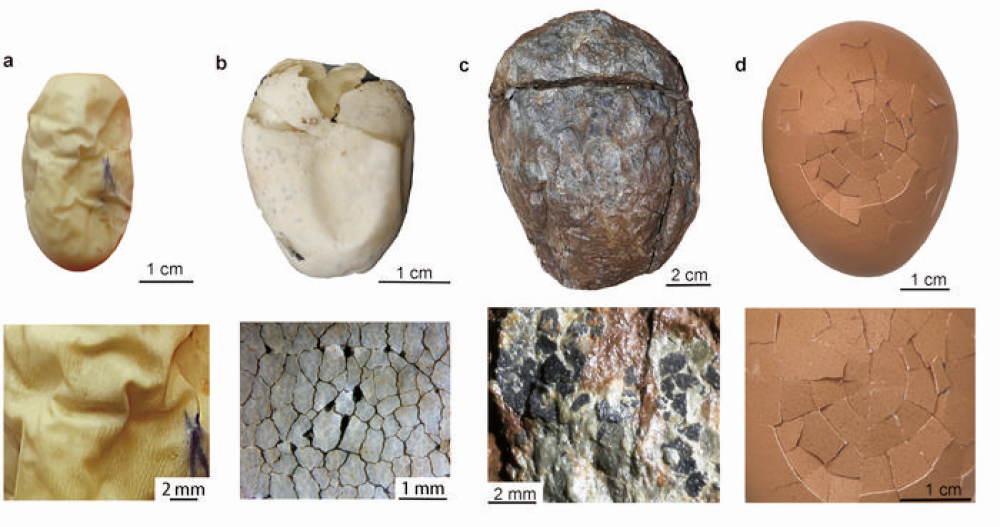
They revealed that the calcareous layer of Qianlong eggs was thicker than that of typical soft-shelled eggs, but still thinner than what you tend to see in fully hard-shelled eggs. Patterns of eggshell fragmentation also revealed that Qianlong’s eggs broke into small surface fragments, something you’d expect of leathery eggshells. Soft shell eggs tend to be folded, whereas hard shell eggs tend to break into large fragments. Ergo, Qianlong laid leathery eggs.
Big news for one dinosaur, but what does this tell us about the evolution of egg types among dinosaurs? Turns out, it taps into a trend that's been emerging in dinosaur egg fossils (and a lack thereof) that could have a logical explanation.
“Over the last 20 years, we've found dinosaur eggs around the world, but for the most part, they only represent three groups – theropod dinosaurs, which includes modern birds, advanced hadrosaurs like the duck-bill dinosaurs, and advanced sauropods, the long-necked dinosaurs,” said the American Museum of Natural History's Mark Norrell, lead author on a 2020 study that investigated the microstructure, composition, and mechanical properties of fossilized dinosaur eggs, in a statement.
“At the same time, we've found thousands of skeletal remains of ceratopsian dinosaurs, but almost none of their eggs. So why weren't their eggs preserved? My guess – and what we ended up proving through [our] study – is that they were soft-shelled.”
Evidence suggests that many sauropodomorphs, like Qianlong, buried their eggs in the same way modern turtles lay eggs in sand. As dinosaur evolution progressed – particularly among non-avian theropods closer to birds – new reproductive behaviors such as brooding began to appear, alongside the evolution of harder, more heavily calcified eggshells.
Fossils of brooding theropods show eggs arranged in circular clutches with a central gap for the adult’s body. In these nests, the adult’s weight was supported by the ground, but the eggs experienced mostly vertical loading – a type of stress that hard-shelled eggs can tolerate.
So, it seems as for the soft vs. hard debate, it’s a bit of both. Early dinosaur eggs were likely leathery, smaller, and rounder, and continued like this until the first major transition in egg morphology occurred early in the evolution of theropod dinosaurs.
But enough about eggs' shelly exterior, have you heard about the bizarre phenomenon of egg-in-egg?