Nature
 PUBLISHED


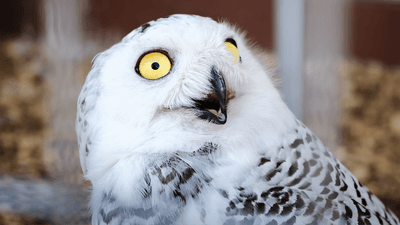


Owls, God bless them, are pretty weird and wonderful creatures, with some strange and impressive adaptations to their environments. Though it's a fact you know well, it's still astonishing that they can spin their head through 270 degrees, like a flying tribute to The Exorcist.
Their concave facial disks, for example, as well as being aesthetically pleasing, channel sound towards their ears.
"The facial disc works by reflecting sound waves like a parabolic reflector, effectively amplifying sounds that might otherwise be imperceptible," Andrew Alpin explains for Bird Life. "This remarkable adaptation allows owls to detect the faintest rustling of a mouse moving beneath leaves or snow, even from considerable distances. Research has shown that the facial disc can improve an owl’s hearing sensitivity by as much as 10 decibels—making sounds appear twice as loud as they would without this specialized structure."
One thing you might not know, or want to know, is that in certain species of owl, it is possible to catch a glimpse of their eyeballs by looking through their ears. Honestly, before you look; it is a little strange to see, and may not be for the squeamish.
This weird sight is possible for several reasons, though of course we should say that it is not true of all species of owl. Let's start with the ears, usually hidden by the feathers on the side of their head.
"Because Owls are generally active at night, they have a highly developed auditory (hearing) system. The ears are located at the sides of the head, behind the eyes, and are covered by the feathers of the facial disc. The 'Ear Tufts' visible on some species are not ears at all, but simply display feathers," the Barn Owl Centre explains.
"The shape of the ear opening (known as the aperture) depends on the species of Owl - in some species, the opening has a valve, called an operculum covering it. The opening varies from a small, round aperture to an oblong slit with a large operculum."
Owl's eyes, meanwhile, are pretty large, around the same size as their brains. And they are not true "eyeballs" as they are not really spherical, but elongated tubes, held in place by bony structures known as "scleral rings". Their large eyes improve their efficiency, especially during times of low light, and provide binocular vision that gives them good depth perception, enabling them to focus well on their prey.
But there is a trade-off that comes with this. While owls, contrary to popular claim, can move their eyes, it is only a tiny amount.
"The tubular shape and tightly encapsulating orbit of the owls eye would seem to make horizontal and vertical eye rotations impossible. The amazing flexibility of the neck, allowing the head to rotate 270 degrees on the torso, would seem to make eye movements unnecessary," a paper which assessed owl eye movement explains.
"These two characteristics have led to the claim that the owl eye is immobile. The authors report the presence of small eye movements less than 1.5 degrees in awake, unanesthetized owls, occurring both spontaneously and elicited by visual and vestibular stimuli."
In short, owls have large, tubular eyeballs that extend into their skulls, and their ears are openings that allow you to look inside their skulls. This includes getting an unsettling glimpse of their eyetubes.


 1
1