Humans
 PUBLISHED
 7
7


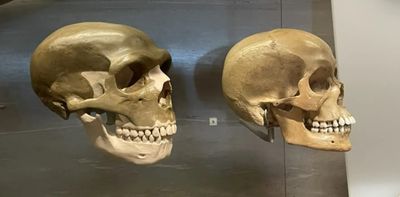


Despite being almost genetically identical to modern humans, Neanderthals had much chunkier faces, with big noses, protruding brows, and large, powerful jaws. Amazingly, these striking differences in physical appearance result from just a few tiny alterations in the so-called “dark” region of our genome.
Sometimes referred to as “junk DNA”, the dark genome refers to the parts of our genetic code that don’t contain any actual genes, and instead consist of instructions for controlling, regulating, and activating genes. It’s thought that around 98 percent of our DNA falls into this category.
According to new research, one particular region of the dark genome seems to be responsible for the very different facial development patterns in Neanderthals and Homo sapiens. "The Neanderthal genome is 99.7 percent identical to the genome of modern-day humans and the differences between species are likely responsible for altering appearance," explained study author Dr Hannah Long in a statement.
To figure out where these differences might be located, the team investigated a region of the dark genome called enhancer cluster 1.45 (EC 1.45), which regulates a gene associated with facial development, known as SOX9. For instance, certain alterations within EC 1.45 are thought to cause a condition called Pierre Robin sequence, which is characterized by an underdeveloped lower jaw and cleft palate.
The researchers wondered whether smaller tweaks to this enhancer region might be responsible for the differences between human and Neanderthal faces. They therefore compared the versions of EC 1.45 possessed by the two species, and found that they differed by just three letters.
To figure out how these tiny differences affect facial development, the study authors inserted both versions into the DNA of zebrafish, and used fluorescent tags to observe when the Neanderthal and human regions were active in developing embryos.
“Strikingly, although differing by only three SNVs [single nucleotide variants], Neanderthal EC1.45 exhibited increased activity during early craniofacial development,” write the researchers. In other words, the Neanderthal version of this enhancer appears to be more powerful than our own, which means the SOX9 gene would have been activated to a greater extent in our extinct sister lineage.
“We found the enhancer is active in an intriguing population of facial progenitor cells, which contribute to jaw formation,” says Long. “Boosting its activity may have affected expression of the target gene SOX9 during development, perhaps contributing to some of the jaw shape differences seen between modern day humans and fossilised remains from Neanderthals.”
To confirm this, the researchers gave zebrafish embryos extra copies of SOX9 and found that this caused their jaws to become larger. Overall, then, it seems that this particular gene – and the sequence of dark DNA that controls it – may be at least partially responsible for Neanderthals’ bulky facial features.
As for the applications of this discovery, Long says that “we hope this will inform our understanding of sequence changes in people with facial conditions and inform diagnosis.”
The study has been published in the journal Development.