Nature
 PUBLISHED


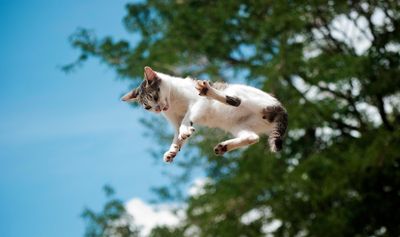


Where would physics be without cats? No Schrödinger’s thought experiment; no FDC Willard; no Cheshire cat effect in the quantum realm; really, the entire discipline would be reduced. But cats without physics? Well, that would be fine. After all, cats have never really obeyed the laws of physics in any case, but particularly when it comes to falling and somehow landing perfectly.
“Conservation of angular momentum means that something can’t just start spinning on its own,” pointed out Hannah Fry, Professor of the Public Understanding of Mathematics at the University of Cambridge, back in 2024. “But falling cats – they seem to manage [it].”
That feline talent of twisting round in mid-air isn’t just a neat survival trick – it’s a movement that genuinely baffled physicists for a long time. “Some of the greatest scientists spent a lot of time chucking cats about – in a kind way – trying to figure it out,” Fry said. “But it was still a mystery.”
It took the invention of the high-speed camera, and an enterprising photographer and scientist named Étienne-Jules Marey, before physicists even accepted that cats could do such a thing – despite, one assumes, a lifetime of having seen the animals doing it. Even then, it was a hard sell: “When M. Marey laid the results of his investigations before the Academy of Sciences, a lively discussion resulted,” reported the New York Herald in 1894. “One member declared that M. Marey had presented them with a scientific paradox in direct contradiction with the most elementary mechanical principles.”
What followed would be more than a century of feline physics: theory after theory as to how cats manage to do what science apparently said was impossible. It’s such an active niche of research that new results are still being submitted – the latest addition to the literature surfaced only a couple of weeks ago.
So… what’s the secret?
Fallin’ felines
Photographs may have proven that cats can twist in the air, but they didn’t provide an answer as to how it happens. “If you’re looking at a series of photographs or a video of a falling cat, it becomes almost a psychological problem,” Greg Gbur, a physicist at the University of North Carolina, Charlotte, and author of Falling Felines and Fundamental Physics, told Ars Technica in 2019. “Different people, their attention is going to be drawn by different aspects of a motion.”
It's understandable, therefore, that so many hypotheses have been suggested to explain cats’ twisty talent. The first, proposed by the mathematician Émile Guyou and endorsed by Marey and most members of the Academy, was the so-called “tuck and turn” model of cat-turning: upon finding itself in freefall, the idea goes, a cat would first extend its back paws and tuck in its front paws, then twist its upper body to face the ground; next, it would tuck in the back paws and extend the front, and twist the lower body.
The “tuck and turn” model was presented quite quickly after Marey’s photos were published – “The academicians were presumably in a hurry to vindicate themselves after the ridicule they had received in the media,” Gbur writes – and it soon had the math to back it up, with a rigorous proof showing that the model did agree with the laws of physics. “The explanation was accepted as fact, and within a few years it had even made it into physics books,” Gbur says. “The problem had seemingly been solved.”
There was just one tiny problem. Cats don’t seem to actually move that way.
So how else might the cats be turning? Another idea, proposed by Giuseppe Peano, held that the trick was in the tails: if a falling cat rotates its tail in one direction, he said, then its body would spin the other way, allowing the animal to right itself before hitting the ground.
But this idea, too, hits a wall. “If you watch videos of falling cats, you will see that a lot of them use their tails to turn over,” admitted Gbur. “But we also know that cats without tails can turn over just fine.”
Curiouser and curiouser
So, how do cats turn round mid-air? Well, truth is, we still don’t know. The best single explanation we have is probably the “bend and twist” model: the cat bends at the waist and rotates the upper and lower halves of its body in opposite directions to swing itself around. “When one goes through the math, that seems to be the most fundamental aspect of how a cat turns over,” Gbur told Ars Technica.
But if a cat turning in the air is the Mona Lisa, that explanation is like a stick person in a triangle dress. Cats do bend and twist – but they also perform myriad tiny corrections, using their tails, paws, and probably any other tools at their disposal to maneuver themselves into the right orientation.
It’s one such tool that’s the focus of a new study out of Yamaguchi University in Japan. “We measured the mechanical properties of the spine under axial torsion and examined their relationship to air-righting behavior,” reports the paper.
It was a two-pronged attack: first, the team studied cat spines taken from cadavers to investigate the flexibility of the bones without harming any live, clawed animals; then, they used the traditional “throw a cat around and film what they do” method to study how a cat moves in real life.
The result: “The thoracic and lumbar spine regions exhibited marked differences in torsional mechanical properties,” they write. In short: a cat’s spine – notably bendy, as vertebrae go – isn’t uniformly flexible all the way down. Instead, the part between the neck and lower back is extremely flexible, able to twist extremely far without any real effort, while the lower spine is much more stable, acting as a kind of anchor while the cat’s front half spins around.
“These results suggest that trunk rotation during air-righting in cats occurs sequentially,” the Yamaguchi team wrote, “with the anterior trunk rotating first, followed by the posterior trunk.”
The high-speed images also revealed the cats extending various limbs as they fell, and if that all sounds a little like Guyou’s original “tuck and turn” model to you – well, you’re not alone. “The new research has made me reevaluate the importance of ‘tuck and turn’, and consider it as a bigger deal than I thought,” Gbur, who was not involved with the new study, wrote last week.
“The flexibility of the upper part of the spine strongly supports this perception that the cat turns to get its head right side up first,” he wrote, “and indicates that its biology is even tailored to make this as easy as possible!”
A paws for thought
So, with this latest installment, is this more than 300-year-long investigation into kitty physics finally resolved? Nah.
“This paper has revealed a little more of a cat’s rotational secrets,” Gbur wrote – but the overarching question is simply too complex for a definitive answer to come from a single paper. Cats are complicated beings, moving in complicated ways, and it’s possible – if not likely – that the method a cat uses to twist in the air is unique to the individual. “From a physics point of view, the problem has reached a level where the details depend on the specific cat,” Gbur told Ars Technica.
But maybe one day we’ll get even closer than we are today. “Part of the reason the problem is so difficult to analyze is that almost all the photo sequences taken are from a single angle at a time,” Gbur pointed out. “It would be really nice in the future to see someone take a multi-angle sequence that could be converted into a 3-D model.”
“I suspect we might learn even more about how a cat performs its twist.”
The study is published in the journal The Anatomical Record.