Nature
 PUBLISHED



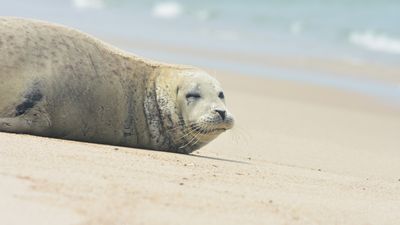


A grisly murder mystery from the shores of eastern Canada has finally gotten a solution – and the perpetrators were right under our noses. According to a new paper, it was the gray seals all along.
To be fair, though, so were the victims. For decades now, hundreds of dead seal pups have been washing ashore every year during the breeding season – newly weaned and ripped apart by some bizarre corkscrewing weapon.
Their bodies were found with huge, gaping wounds, starting at the mouth and winding round down to the chest, where the innards and spines were left open to the elements. It was, marine biologist Claudia Hernández-Camacho at Mexico’s National Polytechnic Institute told Science magazine, “deeply disturbing” to see.
So what could have caused it?
A mysterious massacre
These weirdly mangled seal carcasses have been turning up since the 1980s, but nobody had ever known why. Without any obvious culprit, scientists’ suspicions first fell on human activity: perhaps these strange spiral wounds were caused by the bladed propellers of boats, people suggested. Or maybe it was sharks – some of the bodies seemed to have tooth and rake marks, which pointed to predation. Since nobody had actually witnessed any of the deaths, nobody could do anything but speculate.
Then, in 2024, that changed. Izzy Langley, a marine ecologist at the University of St Andrews in Scotland, was working with gray seals on Sable Island – the largest colony of gray seals in the world, off the coast of Nova Scotia in Canada – when suddenly she saw one, an adult male, attack a pup.
The adult “was observed lying on top of a live, healthy-looking weaned gray seal pup on South beach before it dragged the pup into the water,” Langley and her colleagues report in a recent paper on the phenomenon. “It held the pup by the back of the neck and proceeded to tear off pieces of flesh, repeatedly tilting its head back indicative of feeding behavior.”
Two more pup manglings were seen within the next 10 days alone, with further slam-dunk evidence a year later: “on January 7, 2025, an adult male gray seal was filmed restraining a live, healthy looking weaned pup with its head in its jaw,” the paper reports.
Such violence was unexpected – but not unprecedented. In the mid 2010s, a spate of similarly corkscrewed attacks in Germany and Scotland by gray seals on both harbor seals and their fellow mid-hued pinnipedian brethren led some experts to suggest the same might be true in Canada.
But in over 20 years of surveying the Sable Island population, no such attack had been seen, and local biologists were loath to assume the worst in their charges.
When Langley and others set out to catalogue the carnage, however, they found nothing short of a bloodbath: more than 500 pup carcasses with spiral lacerations on North beach, and about half that again on South beach. (Images of these injuries can be found here. Fair warning though, they are rather graphic.)
At one point, they found more than 350 in a single day. And these wounds were, on closer inspection, clearly the work of fellow seals: they showed bite marks from fangs and claw marks from flippers. Any jury would convict.
How to solve a problem like… cannibal seals
Rather than boats or sharks, then, the mass killings of seal pups seem to be at the hands – or rather the flippers – of the bulls in the colonies. “These pups don’t recognize the adult males next to them as a threat,” Hernández-Camacho, who wasn’t involved in the new study, told Science, “which likely makes the attacks especially shocking to witness.”
That it’s taken so long to discover the guilty party seems mostly to have been bad luck. As the team notes, the colony is tens of thousands strong and surveyed weekly throughout the breeding season – and yet barely a handful of these seal-on-seal murders have ever actually been observed.
It “suggest[s] that gray seal intraspecific predation events mostly occur at times or locations where direct observations are unlikely,” the authors write; “for example, at night, at sea, during high tide, and/or in stormy conditions.”
The trouble is, this raises a new dilemma. If humans were the perpetrators, we could do something about it – banning boats even far away from the island, for example, or closing the area to tourists. But since it’s fellow seals doing the killing, “we don’t know how natural it is,” Ursula Siebert, a veterinary pathologist at the University of Veterinary Medicine Hannover, who wasn’t involved with the work, told Science.
As such, intervention is currently not being recommended, even despite the scale and brutality of the deaths. But given the attacks have been seen on harbor seals too – a species whose numbers are far more perilous than gray seals’ on Sable Island – Langley and her colleagues are understandably keeping an eye on the situation.
“During the period of exponential increase in the gray seal population, the harbor seal population on Sable Island collapsed,” the paper points out. And while much of that decline was attributed to shark attacks, this new evidence behooves the researchers to take a fresh look at the files.
“There are an estimated 80,000 gray seal pups born annually on Sable Island, which represents around 80% of the breeding population in the northwest Atlantic,” the paper points out. “Although there is currently no evidence that the predation of juvenile gray seals in the northwest Atlantic is impacting the gray seal population trend […] the collapse of the harbor seal population on Sable Island should be investigated in the context of gray seal predation and the potential impact this could have on marine mammal population dynamics.”
The paper is published in the journal Marine Mammal Science.