Space and Physics
 PUBLISHED
 3
3



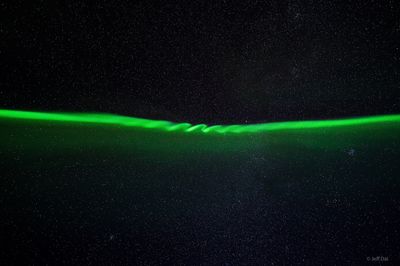


The beauty of Northern and Southern Lights is undeniable, and it is always wonderful when they are caught doing something weird – stunning peculiar behavior that hints at the cosmic forces that make these events possible. Have you ever seen the aurorae do little curls? Well, now is your chance.
Taken by astrophotographer Jeff Dai, a stunning green aurora is seen at its zenith – the highest point in the sky – so we are getting a view of the event from below. The curtain of light is seen curling as though vibrations are going through it, before straightening out again.
Aurorae are caused by the interactions between the electrically charged particles in the solar wind interacting with our planet's magnetic field. The interaction of solar wind and magnetosphere can cause the air above our heads to vibrate like a struck bell, and these curls are examples of such vibrations, called ultra-low frequency (ULF) waves.
The aurorae and ULF tend to occur more often during the peak of increased solar activity, so it is not surprising that they are getting caught now. The Sun is approaching its maximum, the period during which it is at its most active across its 11-year-long cycle. More solar flares, geomagnetic storms, and auroral activity tend to happen during this period.
[H/T: Spaceweather.com]