Nature
 PUBLISHED
 3
3




The relationships between animals that share the same habitats can be complicated and sometimes beneficial. For wolves and red foxes, the species typically seem to coexist with few arguments. In some situations, the foxes can benefit from the reintroduction of wolves, which provide increased scavenging opportunities. This is why the first case of a previously entirely undocumented behavior, a red fox preying on a wolf cub, is so interesting.
The behavior was recorded on camera traps in a protected area called Castelporziano Presidential Estate near the edge of Rome, Italy. Grey wolves (Canis lupus) returned naturally to the area in 2016, and the estate contained a large prey population of different species of ungulates (broadly, hooved animals) available to them.
Then, in April 2025, two denning sites were found using data from GPS trackers worn by the wolves. The camera footage revealed two pups that were filmed around the entrance of the den, as well as adult wolves nearby.
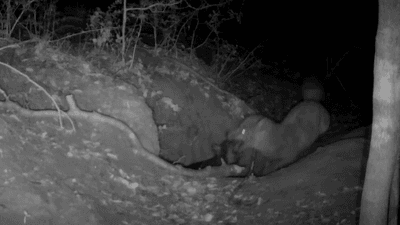
The red fox (Vulpes vulpes) was first seen on May 14, 2025, exploring the entrance to the burrow. Two days later, at night, the camera trap captured what was likely a predation event on one of the wolf pups by the red fox.
At the time, there were no adult wolves present, and the footage shows the fox dragging a live wolf pup outside of the den. The pup initially manages to escape and go back inside, but the fox then attempts to catch the pup a second time, with its cries being clearly audible. The camera does not capture any further footage involving the fox and the pup, but in the daylight, there is only one wolf pup remaining.
Despite the cameras around the den entrance and nearby area, the wolf pup was never captured again on any recordings. Only a single pup was then filmed in the same area at the den entrance and by different camera traps. The fox was seen again at the den entrance on the footage, but the wolf pack soon left the den area, and the remaining pup was seen alive on October 2.
While there is no direct observation from the footage, the team believes this is the first case of a red fox attacking and likely then consuming a wolf pup. The team does not think that the fox was starving – eating the wolf pup as a last resort – given the high proportion of alternative and more typical prey species in the area. This was likely an opportunistic occurrence, which begs the question if such events are happening more than realized.
This interaction suggests a novel behavior that could be limited to this one fox, or it could be replicated in other situations where these species overlap. The team believes this highlights the importance of long-term monitoring and camera traps in the field to provide insights and evidence of unknown behaviors.
The paper is published in Current Zoology.
An earlier version of this article incorrectly stated that grey wolves were reintroduced to the area in 2016. It has been corrected to state that they instead returned naturally.