Space and Physics
 PUBLISHED
 1
1



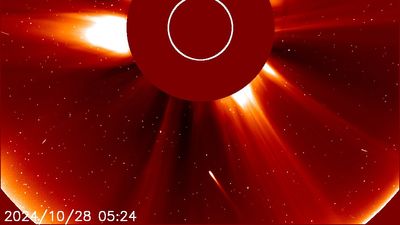


Many across the world have witnessed the spectacle of Comet Tsuchinshan-ATLAS. Some of us, due to constant clouds, were not so lucky. There was, however, hope for a second bright comet this year: Comet ATLAS (C/2024 S1). It was expected to get as bright as Venus by Halloween, but the Sun is a cruel mistress, making these objects bright but also capable of destroying them. That was the fate of this comet.
It passed at its closest point by Earth on October 24 and headed to an extremely close encounter with the Sun on October 28. The perihelion – the closest point to the Sun on a body’s orbit – was just 1.2 million kilometers (750,000 miles). It turned out to be fatal. The comet was evaporated into nothingness – ripped apart by the same light that gave it its tail.
.gif "A gif of the sun activity blocked by a coronagraph and a little comet is seen approaching")
Astronomers knew that there was a risk of the comet being destroyed. It belonged to the Kreutz sungrazer family of comets, objects that often end up being destroyed by the Sun as their perihelion is extremely close to our star. These comets are all fragments of a much larger cometary body that broke apart centuries ago named after Heinrich Kreutz, who first demonstrated their relation in the 19th century.
Several great comets from 1680 onwards have been Kreutz sungrazers. The journey is treacherous, but if the comet survives, it can become extremely bright. Such was the case for the Great Comet of 1965, also known as Comet Ikeya-Seki; it was so bright that it became visible during the day near the Sun.
.gif "A close up version of the above. The comet is seen approaching the sun momentarily getting brighter before fading")
Comet ATLAS (C/2024 S1) seemed to be sizable enough to survive the passage and achieve significant brightness, but it did not. Hopefully we have better luck with the next sungrazer.