Nature
 PUBLISHED


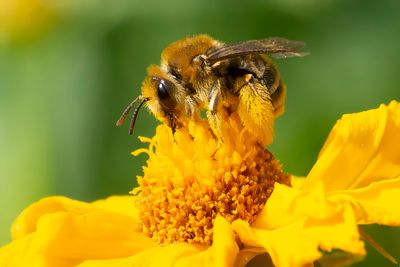


It’s been a tumultuous decade for bees, reputationally speaking. Back at the end of the 2010s, they were on the up: experiments were hinting at a surprisingly smart mathematical brain inside those tiny heads, capable of fairly complex operations like addition and subtraction. They could, it appeared, even understand the concept of zero, which is way more cognitively impressive than it sounds.
Then, everything came crashing down. First, a study came out saying they had been cheating on those math exams that had so impressed us all – they weren’t using numerical cues to solve the tests thrown at them by researchers, but visual ones. Then, California labeled them fish. Repeatedly.
Now, though, the bees are vindicated once again. Not on the fish front – they’re still the Golden State’s buzziest fish, and they should be happy for it. But a new research article has at least put the other debate to rest: bees are, it turns out, smart after all.
“There has been a debate about whether bees are really ‘counting’ or just reacting to visual patterns,” explained Mirko Zanon, from the Center for Mind Brain Sciences at the University of Trento and first author on the study, in a statement Thursday. “Our results show that this criticism doesn't hold when you consider the biology of the animal.”
“When we analyze the stimuli in a way that reflects how bees actually see the world,” he said, “what remains is actual sensitivity to number.”
So, how did they figure that out? Well, it took a realization that is perhaps so obvious as to be easily missed: bees are not the same as humans. Using visual cues that might seem obvious to us – like complicated or overlapping shapes to simulate a higher number – might confound the insects, not because they can’t count, but just because of how their eyes work. It would be like showing a human one of those optical illusions that makes it look like there’s a hole in the floor and saying we have no depth perception – you’re just testing the wrong thing.
“We must put the animal's perspective first when assessing their cognition or we may under or overestimate their abilities,” said Scarlett Howard, a research fellow in the School of Biological Sciences at Monash University and corresponding author of the paper. “We see and experience the world quite differently from animals, so we must be careful of centering human perspectives and senses when studying animal intelligence.”
Howard has long been a big bee-brain believer: it was she who, as part of an interdisciplinary team at Monash and RMIT Universities earlier this year, proposed that understanding the little stripy fellows might be a first step to eventual intergalactic communication.
“We explored the abilities of bees to process numbers, perform mathematics, and learn abstract number concepts,” she told IFLScience at the time. “Through these studies, we found that freely flying bees could understand the concept of zero, categorize quantities as odd or even, add and subtract by one, link symbols with numbers (similar to Arabic numerals), and that they possessed a mental number line for ordering quantities from left to right, like humans.”
This new support for bees’ mathematical prowess isn’t just good news for the insects, therefore – it could be key to some future interplanetary federation. We know, we know: it’s a long shot – but every dream starts small.
“[There’s a link between teaching human number concepts to a distantly related species of insect,” Howard told IFLScience back in January, “[and] the potential design of a universal language that could be used to communicate with intelligent alien life.”