Space and Physics
 PUBLISHED


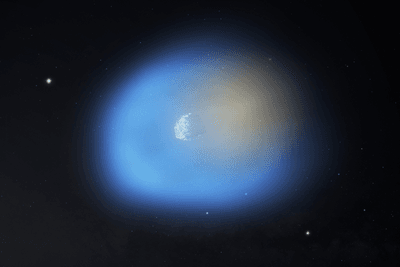


Comet 3I/ATLAS is slowly receding from the inner Solar System, and it is about a week away from its closest pass to Jupiter. The science, though, continues to come in, as astronomers pore over the many months of data after its discovery last July 1. The latest analysis provides new insights into the molecular composition of this interstellar interloper – with one surprising fact.
The observations of 3I/ATLAS come from the Atacama Large Millimeter Array (ALMA) and the Atacama Compact Array. Over multiple days, before the interstellar comet disappeared behind the Sun, the team detected the presence of methanol, a common molecule and the simplest alcohol. On two occasions, they reported the presence of hydrogen cyanide as well.
These two substances are common among comets. They are found in clouds that end up forming stars and planets too. Comet 3I/ATLAS is much older than the Solar System, so its composition reveals that the ingredients of its own star system are very similar… though the recipe might differ. The ratio of methanol to hydrogen cyanide is very different from that of Solar System comets.
The data show that the comet is releasing between 70 and 120 times more alcohol than hydrogen cyanide. This is one of the most methanol-rich comets humanity has ever encountered. It is likely that it formed in different conditions compared to Solar System comets, as other findings about its composition – for example from JWST and SPHEREx – indicate as well.
“Observing 3I/ATLAS is like taking a fingerprint from another solar system,” lead author Nathan Roth, a professor at American University, said in a statement. “The details reveal what it’s made of, and it’s bursting with methanol in a way we just don’t usually see in comets in our own Solar System.”
Thanks to ALMA’s exceptional resolution, the team was able to track exactly where the emissions were coming from. The hydrogen cyanide was being released from the nucleus of the comet itself, while the methanol was seen coming both from the nucleus and from the sublimating ice grains that make up the comet’s fuzzy atmosphere, the coma.
This peculiar emission difference has been seen occasionally in Solar System comets, but it is the first time it has been observed in an interstellar object. Only three interstellar objects have been seen so far, and they have all been pretty different. The first two interstellar objects were 1I/’Oumuamua, discovered in 2017, and Comet 2I/Borisov in 2019.
The study is published in The Astrophysical Journal Letters.