Space and Physics
 PUBLISHED
 1
1




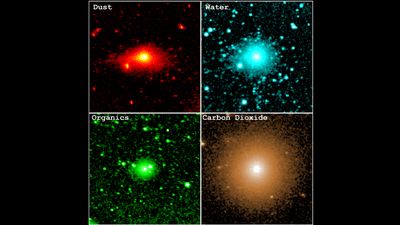


In the past few weeks, a new analysis of interstellar comet 3I/ATLAS has revealed the changes it experienced before and after its closest approach to the Sun in late October. Now, NASA has released images of 3I/ATLAS (see main image) as it moved away from the Sun, following a paper that discussed these insights a few weeks ago.
The paper is available on the ArXiv, a service for hosting manuscripts that have yet to be peer reviewed. We covered it in January, but notes accompanying the manuscript show that it has since been updated ahead of resubmission to the journal Research Notes of the AAS.
The work focused on the observations of this incredible object by NASA’s Spectro-Photometer for the History of the Universe, Epoch of Reionization, and Ices Explorer (SPHEREx), in August and December.
Perihelion, the closest point between an object and the Sun, happened on October 29 for 3I/ATLAS. The comet was 203 million kilometers (126 million miles) from the Sun; that’s about 36 percent further than the average distance between Earth and the Sun. Still, for an object that has not gotten near a star for at least 10 million years, and possibly billions of years, this was an extremely close encounter.
The ices that make up this comet began sublimating with higher intensity during the approach, and thanks to the SPHEREx’s ability to see in 102 colors of the infrared spectrum, the scientists were able to track the shape and emission of the ice, which is made up of different molecules, including water, nitrides, carbon dioxide, and carbon monoxide, among others.
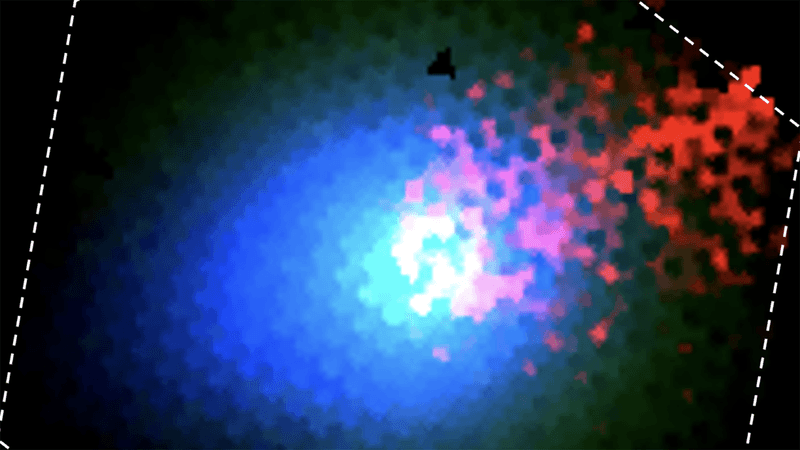
The images show that the general distribution of these various substances is rather spherical, seen as a nice little circular halo around the nucleus of the comet. The distribution of hydrocarbons, however, wasn't quite as circular, but a tad more flattened.
The dust has the biggest asymmetric distribution. It is what forms the anti-tail, a rare extra tail formed by the comet releasing larger, heavier dust particles. The size means that it cannot be pushed about like the rest of the material.
This isn't the full analysis of the December data, but it already provides insight into how much the comet changed as it moved through the Solar System. And there’s more to come!
“The spectrophotometric measurements reported here are from a preliminary analysis. A more full-up treatment will be produced before 3I/ATLAS passes through SPHEREx’s planned survey pattern again in April 2026,” the authors wrote.
The paper is available on ArXiv.