Nature
 PUBLISHED


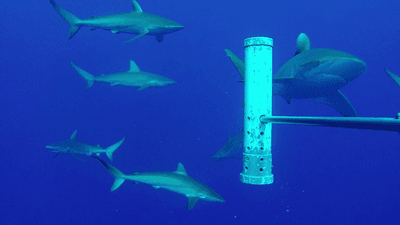


Oh, you didn’t get an invite to the shark party? Shame, because on the underwater mountains off Ascension Island, it’s popping off. New research has revealed that there are 41 times more sharks found here than out in the open ocean, a trend that could indicate seamounts represent vital "hubs" where these animals can socialize, mate, and rest.
The study focused on three seamounts off Ascension Island in the South Atlantic Ocean. Of the three, two were shallow seamounts with less than 100 meters (328 feet) of water separating their peaks from the ocean surface, and it was these two that were the place to be for top predators including Galapagos and silky sharks, as well as yellowfin and bigeye tuna.
The seamount of choice depended on the individual animals, with some being residents of a particular underwater mountain while others visited both seamounts that were around 80 kilometers (50 miles) apart. What's perhaps particularly interesting is that this boom in marine life isn’t as simple as an above average amount of “primary productivity” at the Ascension seamounts.
Were that the case, we’d see the largest amount of biomass in the lower rungs of the food web, getting slightly smaller with each subsequent level, but instead the enrichment of marine life goes up with each level. Zooplankton were still more prevalent on the seamounts compared to the open ocean, with twice as many recorded in the study, but shark biomass was 41 times higher.
“Our findings suggest that several factors combine to make seamounts so rich in sea life, especially predators,” said Dr Sam Weber from the Centre for Ecology and Conservation at University of Exeter in a statement. “While primary productivity is not higher at the seamounts we studied, filter feeders may benefit from prey being ‘blown over’ the peak, and the peak may also stop prey species from retreating into deeper water to avoid predators. This effectively concentrates food in one predictable spot in the ocean.”
“Also, some predators appear to use seamounts as ‘hubs’ to gather, socialise, mate or rest, and as a base to return to after hunting in the open ocean. This may lead to more top predators on seamounts than you would expect based on the amount of food available.”
The results reinforce the idea that seamounts are oases of life in the comparative deserts of the open ocean, with an effect on marine diversity that extends in a “halo” around 5 kilometers (3 miles) into the surrounding ocean. The seamounts studied sit within the Ascension Island Marine Protected Area – a 445,000-square-kilometer (171,815-square-mile) zone where no large-scale commercial fishing or seabed mining are allowed – a critical protection, clearly, given the degree of life here.
“Our results reinforce the conservation significance of shallow seamounts for many top predators,” said Weber. “This research also offers fundamental insights into seamounts’ role as activity hubs and oases for marine species and shows how these remarkable habitats influence the oceans that surround them.”
The study is published in the journal PLOS Biology.