Nature
 PUBLISHED


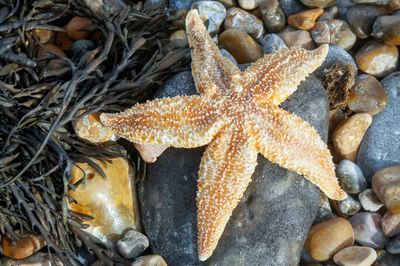


In news that might change how you view Peach from Finding Nemo, scientists have found evidence of interspecies breeding between two closely related sea star species.
The common sea star (Asterias rubens) and the Forbes’ sea star (Asterias forbesi) are commonly found in the rocky intertidal zones of the North Atlantic, where they are considered to be keystone species – their presence has a disproportionate effect on the environment around them.
“Since sea stars preferentially eat dominant competitors, they provide stability to the ecosystem,” said Michael Hickerson, a member of the research team, in a statement.
“These species are therefore crucial to study for marine conservation, as they have rippling effects throughout the rest of the community.”
As some might be able to guess from their Latin names, the two species are closely related, residing within the same biological genus, Asterias, although their lineages diverged around 2 to 3 million years ago. Dubbed “sister species” by scientists, a new study has shown that A. rubens and A. forbesi have been crossbreeding to produce hybrid sea stars, making their nickname perhaps a tad regrettable.
Taking DNA samples from both species at 33 sites in the North Atlantic, genomic sequencing revealed that widespread hybridization had been occurring between the two all the way from Cape Cod to Nova Scotia.
“It is the first genome-wide evidence of extensive hybridization in an ecologically important coastal species,” said the corresponding author of the study, Melina Giakoumis.
The study also found that environmental selection may play a role in where the hybrid sea stars are found. The limited geographic range of A. forbesi suggested that it prefers warmer temperatures, whereas A. rubens likes it chilly – hybrids were found in areas with temperatures suited to both. This was also reflected in their genomes.
The researchers believe this may have implications for how the two species could be affected by climate change and as keystone species, impact their ecosystems.
“Two questions arise from this study,” said Hickerson. “Will the hybrids’ move to follow the changes in sea surface temperatures accelerate to the point of one species replacing the other? Or will they rescue the two species by being a source of gene combinations that allow greater resilience to climatic changes due to increased adaptive variation?”
Inappropriate jokes aside, hybridization is thought to be fairly common in nature – look no further than the evidence suggesting Neanderthals and modern humans regularly got it on. Further research and time will tell if, in the case of sea stars, it can have a significant impact on the surrounding ecosystem.
The study is published in the journal Molecular Ecology.