Space and Physics
 PUBLISHED


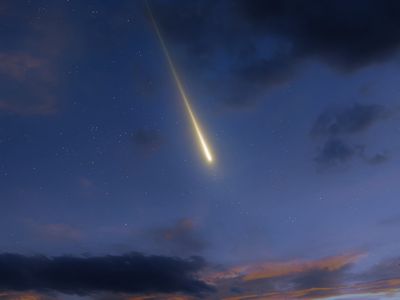


Before we read this study, we assumed that the formation of a meteorite was pretty straightforward. A space rock falls into the atmosphere, gets cooked by the intense friction, falls apart, and peppers the ground. But new work has highlighted that there is a lot more going on.
Researchers studied 75 meteorite falls captured in videos and photographs. Thanks to these, they were able to develop a seven-stage model for how a piece of asteroid becomes a meteor, then a fireball, and eventually a meteorite.
Each of these seven stages is shaped by different physical processes, and the interplay between the meteor and the atmosphere under some pretty extreme conditions.
Phase 1 is probably the most obvious one. We are high in the atmosphere. The air is not dense enough for humans to breathe. For a space rock moving at high speed, on the other hand, there is enough air to create a shock wave. The air molecules hitting the rock heat up, creating a glow. The rock is now a meteor.
Phase 2 begins lower down. The density of the air increases, and the meteor's brightness increases. That is not all; the meteor can also start tumbling.
In the study, the team reveal that the fastest rotating meteors could spin on their axes every 0.5 to 5 seconds.
We get even brighter in Phase 3: the fireball phase.
Most shooting stars and meteors we see in meteor showers are tiny fragments, but larger rocks are fireballs. When a space rock becomes a fireball, the team found that it is mostly losing mass through melting. The collision with the air liquefies the rock’s surface, and droplets are left in its wake, which simply evaporate.
"In the laboratory, we cannot generate the amount of radiation that occurs in a natural atmospheric entry at those speeds," co-author Eric Stern, formerly at NASA Ames and now chief scientist at Hyperspace Technologies, Inc., said in a statement.
"Rock could aggressively fragment and erode instead, but then we would not expect the observed systematics in how fireballs brighten."
At an altitude of about 60 kilometers (about 40 miles), Phase 4 begins. The air is almost 4,000 times less dense than at sea level, and it's where a fireball reaches its melting equilibrium.
Fireballs lose about 40 percent of their mass from the melting, and in this phase they either keep their brightness or get steadily more bright.
"We used to think that solid rocks would evaporate from the enormous heat and brilliant light generated in the air collision," added meteor astronomer and lead author Dr Peter Jenniskens of the SETI Institute and NASA Ames Research Center.
"We found instead that first melting and then fragmentation controls how a rock loses mass."
And it is in Phase 5 that the fragmentation takes place.
This was a bit of a surprise, as it happened earlier in the fall than expected. The forces required are just about 20 percent of the ones expected from measuring meteorites' strength down on the ground.
This is when a fireball flares up. Cracks in the rocks from earlier collisions, combined with the heat of atmospheric entry, break the rock and light up more of the surface. This is when the meteor truly becomes smaller and smaller.
The motion of the fireball alters the atmosphere in such a way that even though the fragments are slowing down significantly, they remain together.
"Our modeling shows that as long as the back of the space rock remains intact, that rock pulls a vacuum in its wake into which fragments tend to flow," said co-author Darrel Robertson of NASA Ames Research Center. "Those small meteorites fall in a narrow strip on the ground."
But before the fall, you need Phase 6, when the fireball has one last bright flare as the slowing fragments spread, and then finally Phase 7: the moment when the fragments have slowed down enough to stop glowing and stop breaking further.
As the melting ends, a thin fusion crust remains on the meteorites. They fall down on a small area, although winds can push them about a bit.
These insights are important not just for understanding how small asteroids form meteorites, but also for planetary protection. How do different types of asteroids behave during those phases? Too many uncertainties remain.
The study is published in the journal Meteoritics & Planetary Science.