Nature
 PUBLISHED
 1
1


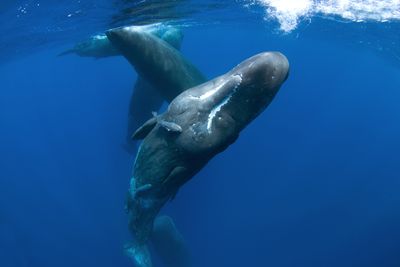


Toothed whales and dolphins are known to hunt using echolocation – but that takes oxygen, which is precious at depth. A new study has revealed whales’ solution, which turns out to be similar to an American trend in speaking style.
Humans have three registers for speaking or singing. There is our normal “chest” voice; falsetto, which allows us to briefly pitch far above our usual range; and vocal fry, where the voice is deepened. Until recently the shortening of the vocal folds to create vocal fry’s raspy sound was the rarest, but it has been made popular by celebrities such as the Kardashians and Scarlett Johannsen. Voice coaches have noticed even people who don’t use vocal fry all the time have started dropping it in, probably unconsciously, as a way to indicate they are relaxed or in tune with their audience.
Like bats, toothed whales emit noises and listen to the reflected sound waves to find prey or detect obstacles. Food is scarce at depths of up to two kilometers (1.2 miles), which toothed whales are known to reach, and whale signals need to sweep a large area. A team led by Professor Coen Elemans of the University of Southern Denmark has shown that the cetacean version of vocal fry is key to how they have managed it.
The authors were puzzled by whales’ vocal range, with the highest frequency an individual whale is capable of being over 10,000 times its lowest. The sounds suited to hunting at depth are very different from those species such as orcas use to communicate amongst themselves at the surface.
It’s been known for forty years that whales make sounds by driving air through their nasal passages, rather than their larynx like most mammals. They’ve evolved folds in their nose known as “phonic lips” as complex as our vocal cords for frequency control. Nevertheless, much of how they do this has been a mystery.
The ideal way to study whale communication might involve them swimming through an MRI machine to observe internal movements, but good luck with that. The researchers made do with tags that recorded dolphins, porpoises, and smaller whale species' sounds while they swam, filming them where possible. It took almost ten years just to develop the techniques required to work out how the sounds were being made, which included blowing air through the nasal passages of dead harbor porpoises.
These experiments demonstrated porpoises and their relatives don’t control the timing of individual clicks, instead adjusting air pressure in their nasal passages and the tension in their phonic lips to produce appropriate click rates.
The team observed the presence of three registers, which they compare to the human equivalents, although they are not sure if the similarity is evolutionary convergence or was inherited from humans and whales’ common ancestor. Previously only humans and crows had been shown to possess distinct registers.
The registers can be distinguished in the waveforms of recordings of sounds for a whale or dolphin species and in observing the phonic lips and accompanying ridges in those cetaceans where these could be seen.
.png "Scan of a harbor porpoise's head showing the two sound source organs, and the fatty melon that conducts sound into the water")
All three registers are produced using the phonic lips and nasal passages, rather than the larynx. It’s the lowest register, corresponding to human vocal fry, that makes the clicks used in echolocation.
In dolphins at least, the left phonic lips make counterparts of the human chest and falsetto registers, which are used to maintain their complex social relationships, and the right lips make the echolocation clicks.
“During vocal fry, the vocal folds are only open for a very short time, and therefore it takes very little breathing air to use this register,” Elemans said in a statement. That’s a very useful trait when you’re not going to be coming to the surface for a long time.
Moreover, as first author Professor Peter Madsen of Aarhus University noted; “During deep dives, all air is compressed to a tiny fraction of the volume on the surface.”
The whales produce up to 700 echolocation clicks a second, and vocal fry allows them to do this using less than 50 microliters of air per click. Without this extraordinary efficiency, whales would be effectively blind below about 100 meters (328 feet) in depth. Instead, they have access to a food source few other predators can reach.
The work is published in the journal Science.