Nature
 PUBLISHED


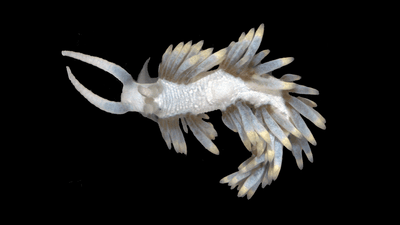


Animals hunting in groups is an amazing example of both intelligence and communication between individuals, from orcas teaming up to sink yachts to prides of lions and packs of wolves taking down prey often much larger than themselves. While these are fairly common examples, taking a trip below the waves reveals that even tiny sea slugs are capable of working together to get the ultimate meal.
The nudibranch mollusk Berghia stephanieae only eats a sea anemone species called Exaiptasia diaphana, however research has now revealed that the nudibranchs are feeding on these anemones in packs.
E. diaphana is dangerous prey – the anemone contains nematocysts and acontia, similar kind of stinging cells to those found on a jellyfish. The anemones are also capable of killing and eating their predators. Therefore, the team believe that much like a lion pride would hunt in a group to take down a dangerous buffalo, the nudibranchs are teaming up to reduce the likelihood of possible injury.
The team conducted a series of experiments in the lab to explore how B. stephanieae would react to different feeding situations. First, they placed one anemone for every nudibranch inside the tank but rather than eat alone, results showed that the nudibranchs fed socially. The feeding together was not influenced by how hungry the nudibranchs were in tests where they weren’t fed for seven or three days.
In a different experiment, the team placed two anemones inside the tank but found that the nudibranchs did not distribute themselves evenly between the pair.
The researchers also thought that the sea slugs could be following slime trails left by the others in the tank, which could influence which anemone they chose to feed on. By placing a nudibranch in the tank to leave trails, but then removing it before it could feed on any of the anemones, the team found that the rest of the sea slugs did not choose to feed on the anemone with the slime trail leading to it any more than chance.
This kind of feeding behavior is known as aggregation, where the individuals behave independently but come together to feed. The team think that having multiple individuals feeding on the anemone reduces the risk of injury for the feeding nudibranchs but have yet to work out the mechanisms that trigger this.
The paper is published on the preprint server bioRxiv and has not yet undergone peer review.