


 Nature
 PUBLISHED


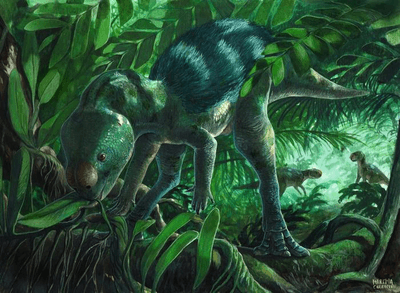


At least five specimens have been discovered of a tiny iguanodont dinosaur that could have an outsized influence on how we see the evolution of much larger relatives.
Jurassic World portrayed a dinosaur petting (and riding) zoo where baby triceratops and sauropods that would become giants were the attractions. However, if such an entertainment park were possible, surely they’d decide the giant species grew up too fast, and use smaller ones instead. If so, Foskeia pelendonum would be perfect, at least if palaeoartists have depicted them correctly. Not only would the species bring squeals of delight, but it could also be particularly educational, although not easy to catch when alarmed.
When small bones were discovered in the Castrillo de la Reina Formation, Spain, in 1998, palaeontologists were initially not sure what to make of them. These were clearly from ornithischian dinosaurs, but as with any examples smaller than their nearest counterparts, it wasn’t immediately obvious if they came from juveniles or fully grown members of a small species.
However, as the number of individual specimens has risen to at least five, and the bones have been analyzed using micro-computed tomography scanning, a team led by Universidad Nacional de Rio Negro's Paul-Emile Dieudonné has concluded that at least one was a sexually mature adult. With similar species of the time being this small, the bones had to come from a new species, which the authors have named Foskeia pelendonum, meaning light Pelendonian forager. The Pelendones were a Celtic people living in pre-Roman northern Spain.
Besides its small size, F. pelendonum has numerous unique features, mostly relating to its teeth, jaw, and hind legs, which have been described in great detail in a new paper. Although most of the paper is taken up with exceptionally detailed descriptions of F. pelendonum‘s mouthparts, for those without a niche interest in the area, the bigger story is the species’ relationship to other dinosaurs.
A 2016 paper on some of the same fossils did not give them a species name, but concluded they were closely related to Muttaburrasaurus on the opposite side of the planet. However, there was a major difference in scale. Muttaburrasaurus, the fossil emblem of Queensland, grew to 8 meters (26 feet) long and may have weighed 3 tons. F. pelendonum’s size has not been specified, but the new paper states, “This ornithopod is one of the smallest ever recovered.”
“Miniaturization did not imply evolutionary simplicity — this skull is weird and hyper-derived,” said Marcos Becerra of Universidad Nacional de Córdoba in a statement.
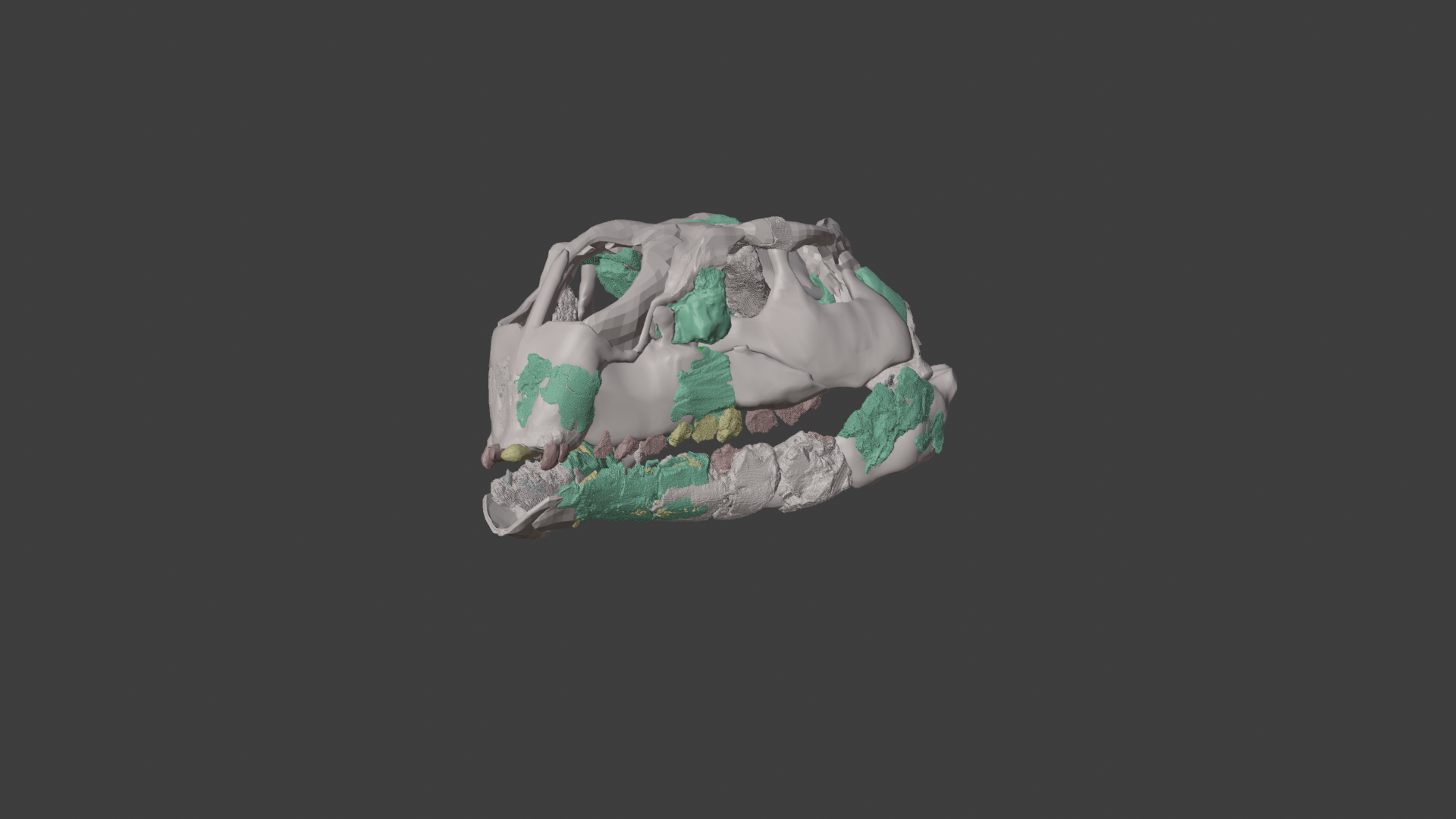
Although we don’t know how the two species ended up only being found so far apart, Dieudonné and co-authors agree on the relationship, and think it makes many things clear.
“Foskeia helps fill a 70-million-year gap, a small key that unlocks a vast missing chapter,” said Tábata Zanesco Ferreira of Universidade Federal do Rio de Janeiro. “This is not a ‘mini Iguanodon’, it is something fundamentally different.” Professor Penélope Cruzado-Caballero of Universidad de La Laguna added: “Its anatomy is weird in precisely the kind of way that rewrites evolutionary trees.”
Unusually, F. pelendonum appears to have walked on all fours when young, before shifting to bipedalism considerably later in life than humans do. Where some dinosaurs relied on burning energy slowly, like many modern reptiles, they could go for long periods without food. Dr Koen Stein of Vrije Universiteit Brussel said it had “A metabolic regime approaching that of small mammals or birds.”
The authors agree with earlier studies that place the fossils now called F. pelendonum in the Rhabdodontomorpha. They expand the European subgroup Rhabdodontia with its addition, arguing that F. pelendonum and Muttaburrasaurus were the first members of the group to diverge, offering insight into others’ origins.
More controversially, the authors consider it a member of the Phytodinosauria, that is, the plant-eating dinosaurs. Other paleontologists have pushed back against the legitimacy of Phytodinosauria as a grouping, since many herbivorous dinosaurs are very distantly related, and may have evolved from meat-eaters or omnivores several times.
In a time of such dangerous predators, animals needed a defense mechanism, and the authors think F. pelendonum used bursts of speed, and the capacity to dodge obstacles in dense forests, to escape.
“These fossils prove that evolution experimented just as radically at small body sizes as at large ones. The future of dinosaur research will depend on paying attention to the humble, the fragmentary, the small,” Dieudonné said.
The study is published in Papers in Palaeontology.



 1
1