Health and Medicine
 PUBLISHED





The human brain is such an efficient computer that our best efforts with wires and silicon haven’t come close to matching it. But what if we could harness the power of the brain within a machine?
Brain-inspired computing seeks to do just that, and scientists attempts to build computer systems that work in a way that’s more similar to the brain are how we ended up with artificial neural networks, without which we wouldn’t have seen the AI boom.
There have also been efforts to fuse the living and the synthetic in innovative new ways, as we saw just recently with a “biological data center” based on living brain cells. Cultures of brain cells can even play video games like Pong and Doom.
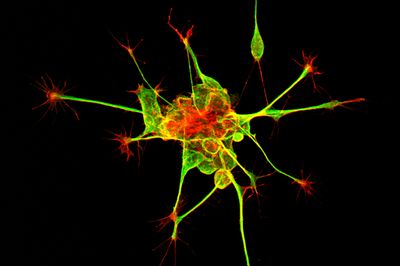
Now, a group of researchers at the University of Bristol in the UK has experimented with "biohybrid" computers made using brain organoids, or “mini-brains.” These are 3D constructs of living tissue grown in the lab with the aim of reproducing as much of the structure and function of a real brain as possible – and they are getting ever-more-sophisticated.
These organoids are not complete brains, something biomedical engineer Dr Annie Kathuria stressed in a previous interview with IFLScience: “Don’t ask if they’re conscious, please. Think of it this way. This is a miniaturized version of your brain. […] I always make this joke in lectures that it’s like iPhone version one.”
In their new study, the Bristol team took human forebrain organoids less than a millimeter across composed of around 10,000 neurons each, as well as other supporting brain cells, and placed them onto electrode arrays that could deliver electrical signals to the cells.
An organoid that size has fewer than 0.00001 percent of the 86 billion neurons estimated to be in the average adult brain. So, as Kathuria said, we needn't throw around any big words like "consciousness" right now. But that’s not to say organoids like these don’t have fascinating implications for research.
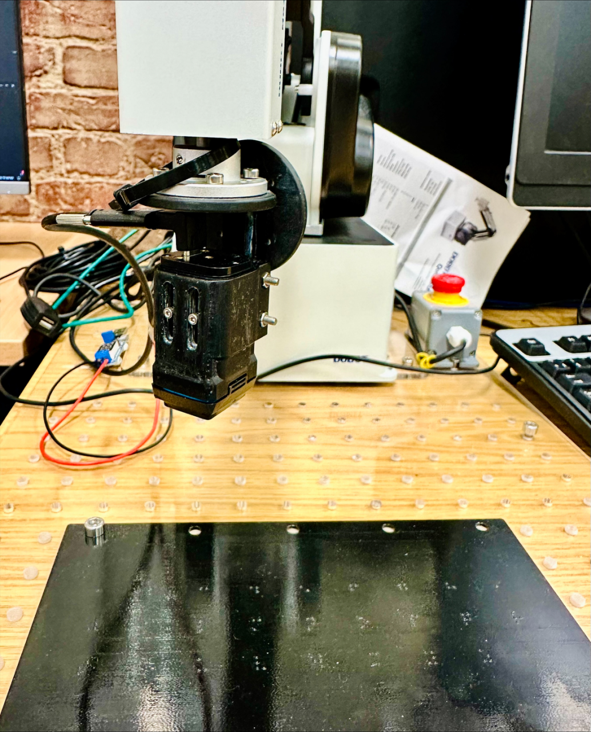
The ones in this study can be kept alive for around 100 days under the right conditions, the authors estimate. That's more than long enough to test their responses to stimuli, which is exactly what the team did. Their aim may sound a bit random at first, but go with it – they wanted to see if the organoids could read braille.
The team recorded tactile data for the 26 letters of the Braille alphabet and converted these to electrical signals that could be sent to the organoids. A machine learning system then decoded patterns of neuronal activity, and they found it could accurately report which braille letter had been input to an organoid about 61 percent of the time.
“We can take information from a real tactile sensor, turn it into a form that a living neural network can receive, and then recover meaningful information from the organoid response,” said first author and PhD candidate Tianyi Liu in a statement. “That gives us a practical way to connect artificial sensors with biological neural systems, which are a very interesting possible route towards more energy-efficient computing.”
When three organoids worked together, the accuracy shot up to 83 percent.
“Different organoids may have slightly different network connections, developmental states, and ongoing activity, so the same input can produce similar but not identical responses. Combining those responses may give us complementary information that we would not get from a single organoid,” suggested Liu.
The researchers even tried to fool the system by adding noise to the data, theoretically making it harder for the organoids to discern what Braille letter was being presented. Interestingly, they found that their machine learning algorithm was easier to trick than the organoids themselves.
Input and output, but no learning yet
It’s important to note that the experiment could not demonstrate whether the organoid computer is capable of learning, only that its response to the input was predictable enough to read back the information that had been fed to it.
“We showed that tactile information could be encoded, processed through the organoids, and decoded, but we did not demonstrate learning or long-term changes in the organoids,” said Liu.
But the team is excited to move on to other types of tactile information next: “we are interested in things such as textures, edges, and different kinds of touch, and eventually in closed-loop tasks where the organoid receives feedback from what it does. “That would allow us to start asking whether the organoid can actually adapt through experience,” added Liu.
Overall, the authors say their study provides promising evidence that organoid-based computing is a realistic possibility for the future.
“This research demonstrates the potential of organoids as low-power, adaptive bio-hybrid computational elements and provides a foundational encoding framework for future scalable bio-hybrid computing architectures,” they write in their paper.
If we can’t beat the brain at its own game, we might as well join it.
The study is published in the journal Frontiers in Artificial Intelligence.