Health and Medicine
 PUBLISHED



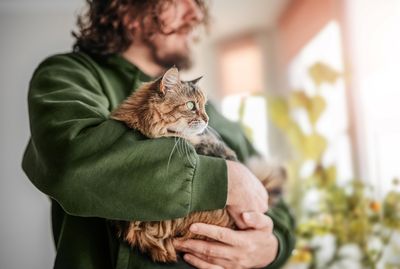


Does your cat actually improve your quality of life? It’s a question many cat owners will enthusiastically answer in the paws-ative, while dog people look on with scepticism.
Some research does offer evidence for this claim, but it’s inconsistent. Other research, for example, suggests the opposite – that owning a cat can have negative effects on human health and wellbeing.
So what’s the answer and why have the existing findings been so unclear? Scientists at Kyoto University, Japan, believe they have an answer and it relates to the physical proximity between cats and their owners, rather than simply owning a cat.
What’s more, the researchers have identified a hormonal connection between cats and their owners. Specifically, two hormones associated with social relationships and stress.
A cat or a dog person
Humans and cats have coexisted for at least 2,000 years. Recent research has shown that domestic cats probably trace their ancestry back to North Africa, which overturned long-held beliefs that our bond formed during the Neolithic in the Middle East.
Clearly, ancient humans saw something they liked in the fluffy felines as they quickly spread across the Roman Empire.
Today, cats are one of the most popular companion animals around the world. In places like Japan, cat ownership even surpasses that of dogs, a gap that is widening.
Pet ownership has been shown to confer a range of benefits for humans. Not only can it reduce illness, but it can also improve psychological wellbeing too. However, the effects of owning a cat appear to be very different from those associated with dogs.
Research conducted in 2016 revealed that dog owners scored higher than their cat-owning counterparts on all dimensions of wellbeing, emotional regulation, need satisfaction, and measures of personality traits.
In an older study from the 1990s, researchers tracked behavior and health changes in adults for 10 months after they became pet owners. They found that the positive health benefits of owning a dog lasted for the duration of the study, while those associated with cat ownership dropped off during the first five months.
In early 2020, a study published by researchers in Japan actually found that cat ownership was negatively associated with mental wellbeing in adolescents, in contrast to dog ownership.
This body of research indicates significant inconsistencies for the effects of owning a cat, especially when compared to the stable and persistent positive effects of dog ownership.
Hormonal connection
These inconsistencies led the researchers of this current study to question whether simply owning a cat provides intrinsic health benefits, or if any benefits or drawbacks come from the quality of the human-cat relationship.
To investigate, they conducted a month-long study of the daily lives of 29 cats and 19 owners who they recruited through flyers and social media (presumably the owners, rather than the cats).
During the study, the researchers analyzed the hormones of both cats and humans through urine samples. They also attached Small Bluetooth Low Energy (BLE) beacons to the cats’ collars to track daily physical proximity to humans while they used questionnaires to assess the owner’s mood and observed the cat’s behavior around different people.
The results demonstrated a hormonal connection between cats and their owners.
Specifically, they found that the levels of oxytocin, associated with social bonding, and cortisol, a stress hormone, were linked to proximity. For instance, a positive correlation between urinary concentrations of oxytocin in both cats and humans was identified, with higher oxytocin levels in cats being linked to lower cortisol levels and fewer negative feelings in humans.
Interestingly, it appears that cats’ oxytocin levels were more closely associated with their owner’s negative mood states, rather than the owner’s own oxytocin levels.
Crucially, this research showed that positive mood effects among cat owners were not connected with how long they owned their cat. Instead, the overall physical proximity between owners and their cats seems to be more significant.
In short, positive feelings appear to be determined by how much time a person spends close to their pet in their everyday life.
"I think many cat owners are familiar with the sense of comfort and peace they feel when their cat climbs onto their lap seeking affection, they start to pet it, and the cat begins purring contentedly," Saho Takagi, an Assistant Professor at Kyoto University, explained in a statement.
"Our findings suggest that this feeling may be partly reflected in the hormonal connection between cats and their owners, particularly through oxytocin, a hormone involved in the formation of parent-child bonds and social relationships."
Despite these results, the study size is pretty small. At the same time, the researchers have only established a connection between these factors, rather than causal mechanisms. The team hopes that future work will examine how cats and humans influence one another in their daily lives.
The paper is published in iScience.