Nature
 PUBLISHED



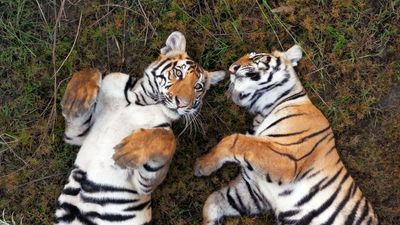


Tigers are known for their fiercely independent spirit and territorial tendencies, making shared babysitting duties seem utterly out of the question, so imagine the surprise when a team in Nepal captured a mother tiger caring for another female's cubs.
The moment was shot as part of Tiger Island, a BBC series that documents the feline wildlife of Bardiya National Park in Nepal. The show focuses on a small river island that harbors one of the highest concentrations of Bengal tigers on Earth.
Using aerial drones, they captured the moment that one mother tiger, called Goma, takes care of three cubs from a different mother, Jugini, while she is away eating.
The two tigers are thought to be related; Goma is possibly Jugini's mother. Even so, this kind of cub-sharing behavior is practically unheard of among wild tigers.
"They are supposed to be incredibly territorial," Dan O'Neill, a big cat scientist working on the series, told BBC Wildlife Magazine.
"Females do not cross paths unless they absolutely have to, they don't share cubs, they don't share parenting duties,” he added.
It’s suspected the two mothers resorted to this behavior to protect their young from aggressive males, which are known to kill cubs that aren't their own offspring. On an island measuring just 4 square kilometers (1.5 square miles), the threat of this occurring is all the more acute.
This is a far cry from the behavior of lionesses, which naturally act as surrogates for one another's cubs by forming communal nurseries known as "crèches," regardless of whether they are genetically related. Lion mothers are even known to synchronize births and share duties to help guard and raise each other's young.
It’s a reflection of the highly social, communal behavior of lions, compared with the tiger's strictly solitary lifestyle (unless mating is involved, of course).
Lions are very much the outlier in this sense; most wild cats default to individualism over communal living. But as this population on Tiger Island highlights, there are always exceptions to the rules.
"I was about to say tigers are solitary big cats, are they? I don't know anymore... You just don't imagine that there are things to learn still about the most iconic animal on the planet, but there is and it's here," explained O’Neill.