Health and Medicine
 PUBLISHED
 1
1





Tick season is in full swing across the US, and if you've been spending time outdoors lately, it's worth being extra vigilant. The Centers for Disease Control and Prevention's (CDC) Tick Bite Tracker, updated on May 24, reports that April 2026 saw the highest rate of emergency room visits for tick bites for any April on record, higher even than 2017 – the furthest back its data goes.
At the time of writing, the site reported that 105 out of every 100,000 emergency room visits across the US in April were due to tick bites. That's compared with a steady average of about 65 visits per 100,000 over the past three Aprils, and, significantly, it now beats the record of 101 visits per 100,000 set in April 2017. The figure has been revised up since the end of last month, when the total was reported to be 96 visits per 100,000.
For the Northeast and South Central US, the April figures are higher than any other year besides 2017, whereas in the Midwest, Southeast, and West, they are the highest on record. The value for the Midwest is particularly high relative to the average for the month, reaching 137 visits per 100,000 compared with a regional average of around 56 over the past nine years.
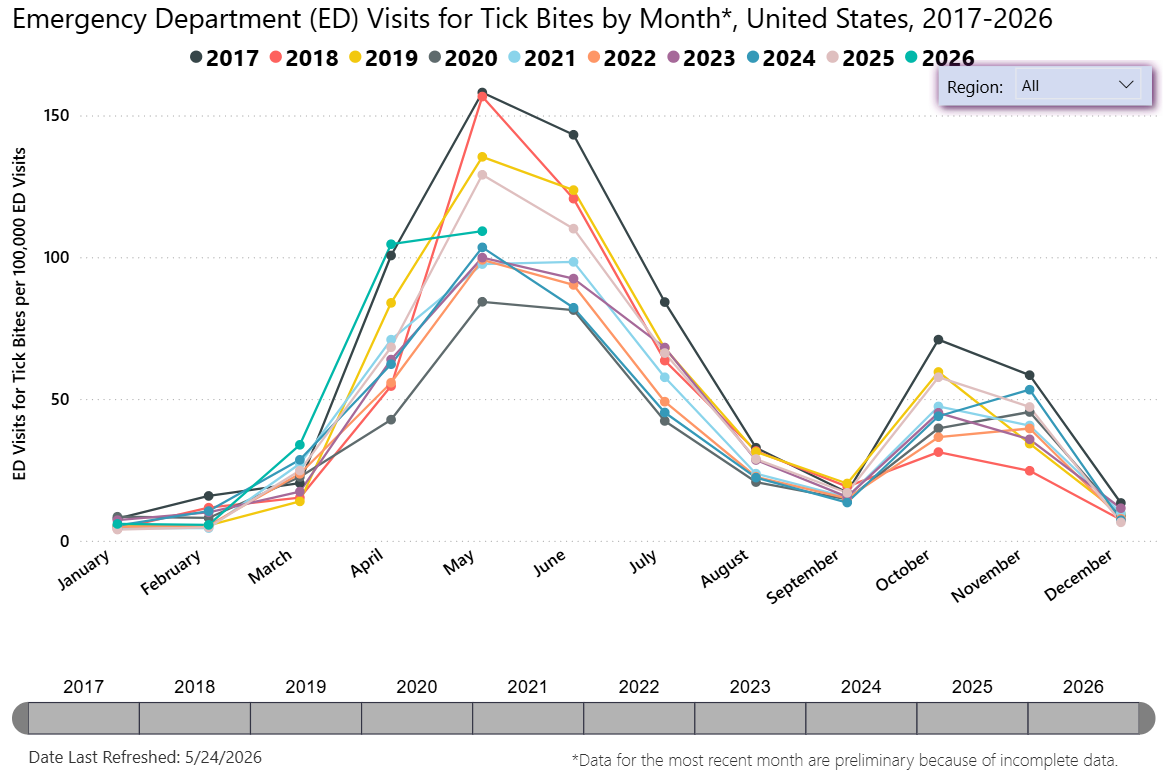
The most recent data available is for the week starting May 4, and it does seem to show a slight downward trend compared with the heights of the end of April, but the CDC notes that its figures for recent weeks and months are still preliminary and potentially incomplete. Tick season typically runs from around March to October and peaks in May, but we will have to wait for the rest of May's data to see whether that trend has continued this year.
"The ticks have started a little earlier. There seems to be a lot of them. A lot of people are going to the emergency room," Dr John J. Halperin at Atlantic Health Overlook Medical Center in New Jersey told ABC News in April. "It's not entirely clear how much of this is increased recognition, and as people become more aware of this, more [are] going to the emergency room. But there seems to be a clear increase in the number of ticks out there."
Ticks are tiny, eight-legged parasites that feed on blood. They sit on grass and low-lying foliage and transfer to animals, including humans, that brush against them. If you're outdoors during tick season and want to take precautions, it may be a good idea to walk more in the center of paths and wear clothing that covers as much exposed skin, particularly around the ankles and calves, as possible.
Tick bites aren't always painful, so it is also a good idea to check areas of exposed skin after going outdoors, even if you don't think you've been bitten. If there is a tick attached to your skin, CDC advice recommends that you remove it immediately using fine tweezers before washing the affected area.
The reason tick bites are such a concern isn't really to do with the bites themselves but that ticks are "vectors" that can cause serious illness in those they feed on through the pathogens they carry. The most common tickborne disease in the US is Lyme disease. Around 89,000 cases were reported through routine surveillance in 2023, but the true number is estimated to be much higher.
Doctors can diagnose the condition if they spot its distinctive bullseye-shaped rash, but around 30 percent of people with Lyme disease never develop one. Other symptoms include fever, headache, and joint pain. If caught early, most cases respond well to antibiotics.
Other diseases to be aware of include Rocky Mountain spotted fever, a potentially fatal bacterial infection, and alpha-gal syndrome, a red meat allergy triggered by lone star tick bites. More than a dozen tickborne diseases have been reported in the US, and they are thought to be on the rise as tick ranges increase in response to warmer weather and milder winters.
The content of this article is not intended to be a substitute for professional medical advice, diagnosis, or treatment. Always seek the advice of qualified health providers with questions you may have regarding medical conditions.