Nature
 PUBLISHED


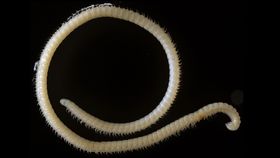


Illacme tobini is a millipede that needs very little introduction: It has 414 legs, no eyes, 200 poison glands, and four penises.
This eyeless millipede has only recently been discovered in a cave in Sequoia National Park near the southern Sierra Nevada mountains in California. It was also described in a new study featured in the journal ZooKeys.
The description came from a sole male individual. As mentioned, its male anatomy was of particular interest. But just in case you thought this millipede's four penises couldn't get any stranger, they’re also modified legs. The ninth and tenth pair of legs are a kind of gonopod, used as a penis-like device to spurt sperm into the female. So romantic.
Bill Shear and Paul Marek, the biologists who found the beast, also noted that this I. tobini was an “evolutionary cousin” of the leggiest animal on the planet – the Illacme plenipes millipede – which has 750 legs. This cousin of our four-penis friend was only recently discovered relatively close by under a giant boulder near San Juan Bautista.
"I never would have expected that a second species of the leggiest animal on the planet would be discovered in a cave 240 kilometers (150 miles away)," Paul Marek, assistant professor in the Entomology Department at Virginia Tech, said in a statement.
The press release noted that Shear and Marek's discovery has reinforced the idea that “by exploring our world and documenting the biodiversity of this planet we can prevent anonymous extinction, a process in which a species goes extinct before we know of its role in the ecosystem, potential benefit to humanity, or its beauty.”
Although, beauty might be a funny word to describe it in this case.

The millipede's 9th and 10th pair of legs, which also act as penises. Paul Marek, Virginia Tech.