Space and Physics
 PUBLISHED


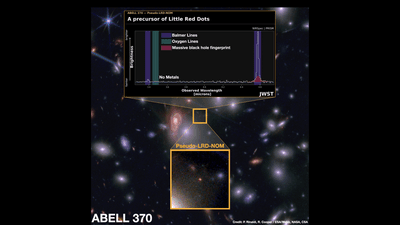


Astronomers have found a curious new object in the heavens: a small, very young compact galaxy undergoing an episode of star formation. The team believes that this object, simply known as Pseudo-LRD-NOM, could be the progenitor of the exciting and very mysterious new class of objects known as Little Red Dots.
Little Red Dots, or LRDs, are extremely compact cosmic objects found in the early universe. They were discovered by JWST and so far do not have a single successful explanation for what they are. Proposals range from black holes surrounded by a large envelope of glowing gas – AKA a black hole star – to the seed of supermassive black holes and the building blocks of galaxies.
The lack of metal lines was the real surprise and the indication that this object was something very special.
Dr Karina Caputi
Pseudo-LRD-NOM (where NOM stands for no metal line) might finally provide some clarity. The observations of LRDs so far have shown the likely presence of a black hole but not of a galaxy around it. A headscratcher for astronomers.
“The problem is that the galaxies around the host are not detected. And normally, there’s a common proportionality expected between the mass of the black hole and the mass of the galaxy," Dr Karina Caputi, Professor of Observational Cosmology and High-Redshift Galaxies at the University of Groningen, told IFLScience.
"Now, [in the LRDs], those laws were totally broken. So people started to say: 'Has the black hole formed before the galaxy? How could this happen?' And this is still under debate."
Pseudo-LRD-NOM is believed to be just 10 million years old, truly a baby galaxy, showing no enrichment of heavier elements (the ‘metals’ in NOM). This was very surprising as heavier elements are formed quickly in strongly star-forming galaxies.
It was clear the object required further attention. Its light comes from just 1 billion years after the Big Bang. JWST observations suggest that the team, while looking for compact sources, found something unexpected.
“The lack of metal lines was the real surprise and the indication that this object was something very special,” Dr Caputi told IFLScience.
“After a lot of modeling and analyzing the spectrum in the data, we realized that this is a combination of a very young galaxy, which is metal poor, at the early stages of chemical enrichment, but also with gas at a very high density, preventing the typical mechanisms that produce metal emission lines.”
The combination is already fascinating by itself. We don't stumble onto baby galaxies every day. On top of that, the team was able to find evidence of a supermassive black hole, estimated to be 5.6 million times the mass of the Sun, already bigger than the one at the center of our galaxy. Taken all together, this suggests not just a special object, but something that could be a game changer in galaxy evolution.
“Some galaxy theories predict that this is the early stage that will give rise, after compacting, to a Little Red Dot,” Dr Caputi said.
This discovery is a fundamental step in unraveling the mystery that surrounds LRDs. But it’s only the beginning. The team will continue studying Pseudo-LRD-NOM with JWST and the ALMA observatory.
“We want to follow this object up with different telescopes and instruments to try to understand to what extent the lack of metal lines is due to the fact that the source is metal poor and it's at the beginning of chemical enrichment and to what extent this is an effect of high density and high pressure of the gas,” Dr Caputi told IFLScience.
The two observatories study the universe in different wavelengths, so they can look at different properties of the gas. And that’s not all.
“But also, we want to find more, right? Because it would be a pity if this is just one of a kind. Ideally, we would like to see a whole sequence: different objects forming, showing different stages of how you reach the state of a little red dot. And, well, we are looking for more objects!”
The discovery was presented at the Annual Meeting of the European Astronomical Society in Lausanne, Switzerland. The result has been accepted for publication in The Astrophysical Journal and can be read on the arXiv.