Nature
 PUBLISHED



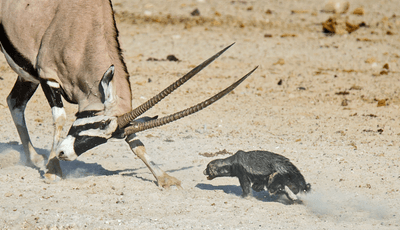


Even if you're a much-feared predator and a skilled brawler, you should never mess with a honey badger. Armed with a striped, stocky body, these feisty freaks of nature have rightfully gained a reputation for being fearless and as tough as nails, which is a great achievement for an animal the size of a small dog.
The honey badger, aka the ratel, is the only living species in the genus Mellivora and the subfamily Mellivorinae. Through their hardiness, they have taken over a geographical range that covers a significant part of the Eastern Hemisphere, from Africa and Southwest Asia to the Indian subcontinent, each part of which hosts a slightly different subspecies.
They get their name, unsurprisingly, from their tendency to raid beehives in search of larvae and honey. However, honey badgers eat a variety of food consisting of pretty much anything they can get their claws on, including rodents, small mammals, reptiles, birds, and eggs.
.jpg "Honey badger, Mellivora capensis, carrying young pup in her mouth at Kgalagadi Transfrontier Park, Northern Cape, South Africa")
A bizarre instance came to light in 1998 when researchers collected the empty shells of 63 tent tortoises in the Nama Karoo biome of South Africa, nearly half of which had been cleanly cracked open with their innards scooped out. Based on tracks found at the scene of the crime, the prime suspect was the honey badger.
Venomous snakes are another favourite prey of the honey badger. This invariably means suffering the odd bite, although the badger has evolved a resistance to many snake venoms thanks to a mutated nicotinic acetylcholine receptor that prevents some neurotoxins from binding to their cells.
Contrary to rumors, they don't eat adult lions, although there is some evidence of them preying on their young. In reality, honey badgers are preyed upon by lions, leopards, and hyenas. However, as plenty of footage − such as the below − shows, they will put up a hell of a good fight against any adversary.
Beyond their sassy attitude, the honey badger is built for tooth-to-tooth combat. Its skin is so thick that it can withstand bee stings, porcupine quills, and dog bites. Despite the bulky appearance of it body, the skin fits loosely around its frame, making it very difficult for enemies to grasp. If a predator’s jaws clamp onto its neck, the badger can pivot within its skin to launch a ferocious counterattack.
Despite their antagonism, they do have some capacity for cooperation. A 2023 study argued that some populations of honey badgers work alongside honeyguide birds to exploit bees' hives. After interviewing 400 human honey-hunters across Africa, most were skeptical about whether this mutualistic relationship existed, but three communities in Tanzania reported witnessing these interactions on a few rare occasions.
Even tough guys need a little help from their friends sometimes.


 2
2