Space and Physics
 PUBLISHED
 1
1



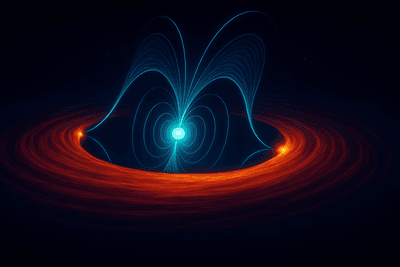


An international team of astronomers has gained new understanding of some of the densest objects in the universe and where the source of their X-rays is. This is all thanks to PSR J1023+0038, or J1023 for short, a transitional millisecond pulsar, which spins on its axis almost 600 times every second.
Pulsars are a type of neutron star, the dense collapsed core of a star that has gone supernova. These pulsars emit powerful beams of light, and as they spin, the beams pulsate. In the case of J1023, this happens 35,520 times every single minute. Well, as long as it is active – because this system has the peculiarity of switching itself off and on again.
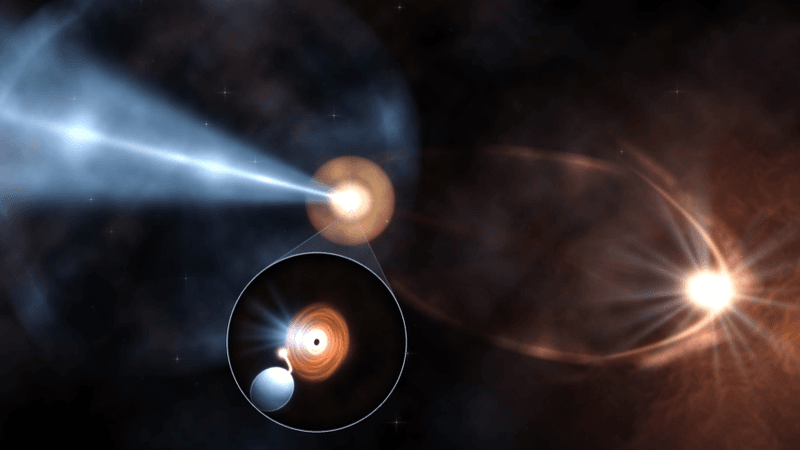
The system experiences radio pulsation during its dormant state, while in its active state, the pulsar is stealing material from its companion, a small star about a quarter of our Sun's mass that orbits the pulsar every 4.75 hours.
“Transitional millisecond pulsars are cosmic laboratories, helping us understand how neutron stars evolve in binary systems,” lead author Cristina Baglio of the Italian National Institute of Astrophysics (INAF) Brera Observatory in Merate, said in a statement.
Baglio is not overselling it. Thanks to the X-ray space observatory IXPE, a collaboration between NASA and the Italian Space Agency, as well as several other observatories across the wavelengths of light, the team was able to work out that the X-ray emission of pulsars comes from the pulsar wind, a flow of high energy particles and magnetic fields that stretch into the accretion disk of stolen material from the companion.
It was the disk that previous models suggested as the source of the X-rays, but these observations challenged that. Using polarization, the angles at which lights oscillate, they looked at the gamma-ray emission with NASA’s SWIFT and NICER telescopes and radio emission from the European Southern Observatory's Very Large Array. The angle of polarization matched.
“That finding is compelling evidence that a single, coherent physical mechanism underpins the light we observe,” added co-lead author Francesco Coti Zelati of the Institute of Space Sciences in Barcelona.
“IXPE has observed many isolated pulsars and found that the pulsar wind powers the X-rays,” said NASA Marshall astrophysicist Philip Kaaret, principal investigator for IXPE at NASA’s Marshall Space Flight Center in Huntsville, Alabama. “These new observations show that the pulsar wind powers most of the energy output of the system.”
The study is published in The Astrophysical Journal Letters.