Nature
 PUBLISHED
 1
1


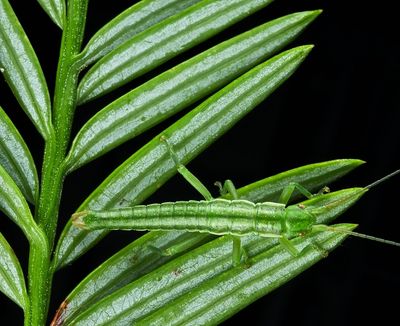


The ability of animals to reproduce on their own has evolved over and over again. But one group has been doing it longer than most: meet the Timema stick insects.
Known more technically as parthenogenesis, literally “virgin birth”, the bugs hold the record for the longest known period of asexuality of any known insect. Asexuality in this case refers to the ability to reproduce without sex, as opposed to the sexuality within human culture.
This long, sexless period gives biologists interested in the mechanisms of genetic sex an incredible opportunity to probe some of the most intriguing questions.
One of these is about how quickly it takes biological systems to decay. It would be expected that if a particular mechanism is no longer needed, the species might get rid of it. But a new study of rare male Timema stick insects shows that this isn’t necessarily the case.
“Males and females have a different number of X chromosomes; males have one (XY), and females have two (XX),” explains Dr Darren Parker, from Bangor University, in a statement.
“The result of this is that gene expression needs to be balanced equally between them. Species have evolved a wide range of mechanisms known as ‘dosage compensation’ to do just this. But what happens when these mechanisms for equally sharing male and female genes are no longer needed?”
“This is the precise situation found in asexually reproducing stick insects. Because the females reproduce without fertilization from males, there is no need to equalize gene expression. By investigating gene expression in rare males, our study found that rather than decaying away as we expected, dosage compensation mechanisms remained fully functional despite not being needed for over a million years.”
A million years without sex
It’s historically been thought that asexuality is unable to persist for a long time in nature. The reasoning for this usually boils down to the reduction in genetic diversity within individuals, and so a reduced ability to adapt to changes in the environment.
It would mean that if, for example, a pathogen were to evolve and spread it would be more likely to wipe out an entire genetically similar population compared to one in which individuals vary.
As with most things in nature, however, there are exceptions.
The western US is home to a group of stick insects within the Timema genus. Out of around 21 species, five have evolved parthenogenesis. Amazingly, it is thought that each of these species evolved this asexuality independently.
By looking into the genetics of each of these species, and using that as a form of genetic “clock”, researchers have been able to see that while some species evolved parthenogenesis about 500,000 years ago, others did it almost 2 million years ago.
While this is the longest period of asexuality known in insects, it is blown out of the water by other animals.
Ancient asexuals
A little-known group of animals called bdelloid rotifers are thought to have evolved asexuality up to 100 million years ago, and have carried on doing it by themselves ever since.
That record, however, is easily smashed by species of soil mite, technically known as the Oribatida. While these might look like insects, they’re actually arachnids and more closely related to spiders and scorpions.
This group is notable not just because asexuality has evolved independently countless times within the 12,000 or so species, but because it also contains a species that has re-evolved sexual reproduction. This was thought to be impossible, and had never been seen before in any other species.
But the mites break the rules in all sorts of other ways too, because it is thought that some species have been quietly reproducing by themselves not for 1 million years, or even 10 million, but for a staggering 300 million years.
How they do this is not really known, but is probably related to their sheer abundance in the soils, meaning they are able to maintain a much greater degree of genetic diversity than is possible for other species.
The study is published in the journal Proceedings of the National Academy of Sciences.