Space and Physics
 PUBLISHED





The search for life beyond Earth is one of the big challenges when it comes to exoplanets. Sure, we want to study how different systems form and why many look different from our own, but we would also like to find Earth-twins: habitable worlds that might host life. Researchers have now selected the 45 most likely exoplanets to be Earth-like.
The team featured three undergraduate students and was led by Professor Lisa Kaltenegger, director of the Carl Sagan Institute at Cornell University. They used data from the recently retired European Space Agency's Gaia mission and the NASA Exoplanet Archive.
They looked at how much light these planets get from their stars, their sizes and masses, ages, and even the eccentricity of their orbits – that’s how circular or non-circular the orbit is. In the scenario they call the empirical habitable zone, they found 45 worlds out of 6,000 that fit the description. In the more strict 3D-Habitable Zone, they found 24 worlds.
"While it's hard to say what makes something more likely to have life, identifying where to look is the first key step – so the goal of our project was to say 'here are the best targets for observation'," Gillis Lowry, now a graduate student at San Francisco State University, said in a statement.
"We wanted to create something that will enable other scientists to search effectively and we kept discovering new things about these worlds we wanted to investigate further," fellow researcher Lucas Lawrence, now a graduate student at the University of Padua in Italy, added.
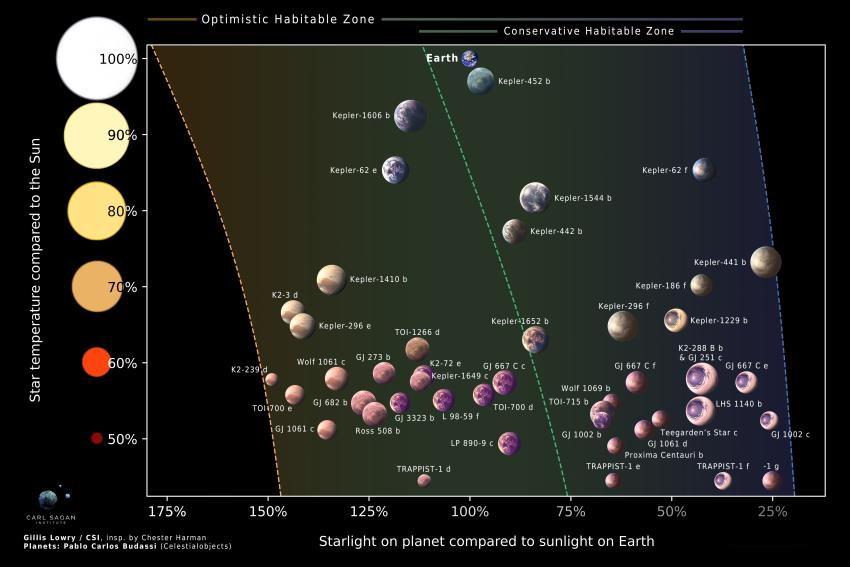
"We know Earth is habitable, while Venus and Mars are not. We can use our Solar System as a reference to search for exoplanets that receive stellar energy between what Venus and Mars get,” added the third undergraduate researcher, Abigail Bohl at Cornell University.
"Observing these planets can help us understand when habitability is lost, how much energy is too much, and which planets remain habitable – or maybe never were. The same idea applies to eccentric planets: how much orbital eccentricity can a planet have while still holding onto its surface water and habitable conditions?
These are promising candidates, but they might not be habitable once we take a closer look. There are more details necessary to work out. Can they hold on to their atmosphere for long enough? Have they got the right ingredients for life to evolve there? There are many uncertainties, but this catalog is a great place to start for follow-up observations. Professor Kaltenegger likens this to the new Ryan Gosling movie, Project Hail Mary.
"As Project Hail Mary so beautifully illustrates, life might be much more versatile than we currently imagine, so figuring out which of the 6,000 known exoplanets would be most likely to host extraterrestrials such as Astrophage and Taumoeba – or Rocky – could prove critical, and not just to Ryan Gosling," Professor Kaltenegger said.
"Our paper reveals where you should travel to find life if we ever built a 'Hail Mary' spacecraft."
Their research was published in the Monthly Notices of the Royal Astronomical Society.