Nature
 PUBLISHED


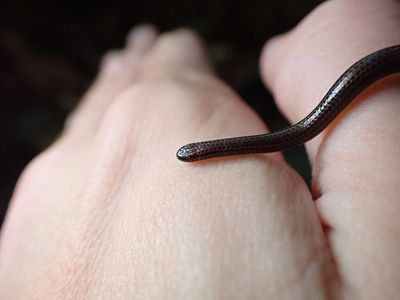


For some ophiophobes, even the thought of a snake is enough to set pulses racing. But while there might be something to fear from the pythons and king cobras of the world, surely most people could be persuaded to enjoy the world’s smallest snake? Meet the Barbados threadsnake.
Measuring just 10 centimeters (4 inches) long, the Barbados threadsnake (Leptotyphlops carlae) holds the Guinness World Record for the smallest snake in the world. The species only weighs around 0.6 grams, barely more than a single peanut.
The threadsnake was actually lost to science for 20 years, with only a handful of confirmed sightings since 1889. However, it was rediscovered in March of this year hiding under a rock during an ecological survey.
“When you are so accustomed to looking for things and you don’t see them, you are shocked when you actually find it,” said Justin Springer, Caribbean program officer for Re:wild, in a statement released at the time. “You can’t believe it. That’s how I felt. You don’t want to get your hopes up too high.”
Very little is known about the ecology of the threadsnake. They are blind and, given their size, have always been difficult to find in the wild. They also closely resemble another species, the Brahminy blind snake (Indotyphlops braminus), an invasive species that was accidentally introduced to Barbados.
Brahminy blind snakes are nicknamed the "flowerpot snakes" because of their habit of hitching rides in flowerpots to other parts of the world. Originally from Asia, the snakes are totally harmless and are often mistaken for earthworms.
The two species are so similar that a magnifying glass is needed to correctly tell them apart.
Barbados threadsnakes spend much of their time hidden in leaf litter in moist forests. They are known to feed on the adults and larvae of ants and termites. While their breeding behavior is not well-studied, it is thought that the female lays only one egg and the hatchling emerges at half the size of the female.
The IUCN lists the Barbados threadsnake as Critically Endangered. Many endemic species have gone extinct on Barbados as 98 percent of its primary forests have been cleared in the last 500 years.