Humans
 PUBLISHED
 10
10


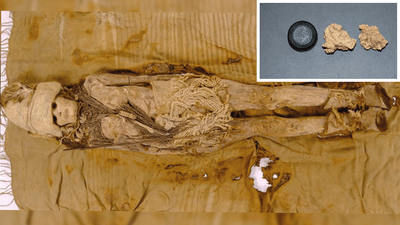


Around 20 years ago, a group of archaeologists made a curious discovery: something had been smeared on the heads and necks of several mummies in the Xiaohe cemetery in Northwestern China’s Tarim Basin. It was a whitish substance, and clearly very old, but nobody knew exactly what it was. Now, a new study has been able to solve the mystery: they were looking at the world’s oldest known cheese sample.
The Tarim Basin mummies date back around 3,300 to 3,600 years, placing them in the Bronze Age. They have an interesting origin story all of their own, but there’s no time for that now because we’re here to talk about cheese.
Yes, thanks to over a decade of advancements in DNA analysis technologies, a team of archaeologists was able to confirm that the white substance was a kind of cheese by extracting mitochondrial DNA from samples. Doing so turned up cow and goat DNA (stranger cheese varieties are possible), and even the genetic material of microorganisms.
The ancient cheese is kefir cheese, similar to yogurt but with a tangier taste and milkier consistency. It contained the same bacterial and fungal species that we find in kefir grains today, and provided an opportunity to study how the bacteria Lactobacillus kefiranofaciens has evolved over the last 3,600 years.
In the modern era, there are two key types of L. kefiranofaciens: one that comes from Russia (which is the most used) and another from Tibet. The L. kefiranofacians in the world’s oldest cheese is actually most similar to the Tibetan variety around today, challenging a long-held belief that kefir originated from the North Caucasus mountain region of Russia.
“Our observation suggests kefir culture has been maintained in Northwestern China’s Xinjiang region since the Bronze Age,” said Qiaomei Fu, of the Institute of Vertebrate Paleontology and Paleoanthropology, Chinese Academy of Sciences, in a statement.
“This is an unprecedented study, allowing us to observe how a bacterium evolved over the past 3,000 years. Moreover, by examining dairy products, we’ve gained a clearer picture of ancient human life and their interactions with the world. This is just the beginning, and with this technology, we hope to explore other previously unknown artifacts.”
As for why the cheese was rubbed on the heads and necks of the Tarim Basin mummies, it seems that it must have been a valuable resource when they were alive.
“The main concern is that it’s important for their life,” Fu told IFLScience, “since the cheese was found in 10 tombs and mummies.”
Which begs the question: what cheese are you taking to the grave?
The study is published in the journal Cell.