Nature
 PUBLISHED
 2
2



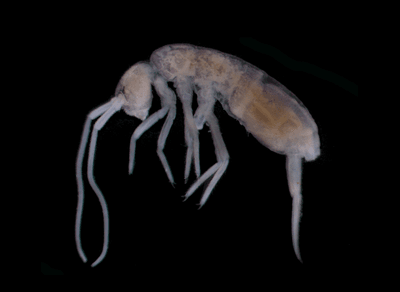


In a cave nearly 2,000 meters (6,561 feet) below Earth’s surface, scientists discovered an ecosystem quietly thriving in the absence of light. Among the trove of troglobites was a character known as Plutomurus ortobalaganensis, which holds the title for being the deepest land animal ever found on Earth.
The deep-dwelling lifeform was discovered in the summer of 2010 by the Ibero-Russian CaveX team expedition within the Krubera-Voronja cave system in the Western Caucasus, one of the deepest known caves on Earth. Their findings were published in the journal Terrestrial Arthropod Reviews in 2012.
It was found at 1,980 meters (2,165 yards) below the surface, making it the deepest land arthropod ever found. Prior to this, the record was held by a species of worm discovered at a depth of about 1,300 meters (4,265 feet) at a gold mine in South Africa.
The creature is a springtail, an arthropod that looks a lot like an insect but actually belongs to a different branch of the tree of life. It isn’t much of a looker; it’s a grayish, eyeless creature with six legs adapted to life in perpetual darkness, feeding on fungi and decaying organic matter. The top of its head is kitted out with an extremely long pair of antennas, which it uses to detect chemical cues and navigate the lightless environment.
“In response to these conditions, none of these animals have eyes, and lack pigmentation,” Dr. Enrique Baquero, a zoologist and a professor at the University of Navarra in Spain and one of the authors on the study, told the media in 2012. “In addition, one of the species has developed a chemoreceptor – a kind of chemical parabolic antenna – which permits it to move in such a complicated environment.”
“They feed on the fungi that grow on it, contributing to its decomposition and participating in the network of stable communities of arthropods that exist in the caves,” added Dr. Baquero.
Most creatures that live in deep caverns lose their pigmentation entirely. After all, who needs color when you live in total darkness, surrounded by eyeless organisms? Interestingly, while this springtail is extremely pale, it is not completely devoid of pigment. That subtle trace of color has led researchers to speculate that the species may have colonized these extreme depths relatively recently in evolutionary terms.