


 Space and Physics
 PUBLISHED


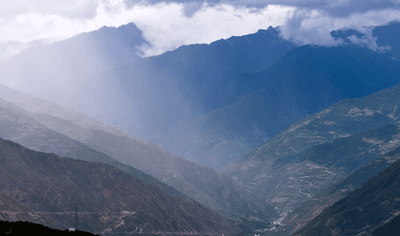


Around 2,400 meters (7,874 feet) below the Jinping Mountains in China’s Sichuan Province, the world’s deepest laboratory is quietly unraveling the mysteries of the universe.
The China Jinping Underground Laboratory (CJUL) became fully operational in December 2023, swiping the title of the “world’s deepest lab” from another dark matter lab called SNOLAB, located around 2,000 meters (6,562 feet) below the surface of Ontario, Canada.
Along with being the world's deepest, CJUL is also the world’s largest underground laboratory with a total area of 330,000 cubic meters (11.7 million cubic feet).
It serves as a hub where multiple research projects and universities carry out several different experiments, all of which aim to answer one question: what the hell is dark matter?
Dark matter does not emit, absorb, or reflect light, nor any other forms of electromagnetic radiation, making it "invisible" and tricky to detect. We know it exists, however, because we can see the gravitational effect it seems to have on visible matter.
Somewhere between 1 to 10 percent of the universe is made of familiar “normal” atomic matter, while the rest is made up of dark energy and dark matter.
One of the best approaches to sniff out this mysterious stuff is to head underground. Dark matter laboratories are typically located below the Earth to shield them from cosmic rays and other background radiation that bombard the surface. These high-energy particles can interfere with the sensitive detectors used to search for dark matter interactions, creating false signals that muddy the waters.
Going underground doesn’t totally erase this problem, though. Radon is a radioactive gas that is constantly seeping out of surrounding rocks and can be a major source of interference in deep underground experiments. As such, the surface of the CJPL is coated with a thick layer of special materials that blocks out 99 percent of the radon gas.
Deep within the CJUL, sheltered by kilometers of rock, the cosmic ray rate is under 0.2 muons/m2/day, making it the best-shielded underground laboratory in the world. This ideal setting provides the potential to gather some of the sharpest insights into dark matter yet.
The US has a similar facility called the Sanford Underground Research Facility, located 1,478 meters (4,850 feet) beneath the Black Hills of South Dakota.
Scientists are still yet to make a direct detection of dark matter – we don’t even really understand its precise properties – but it is underground labs like CJUL and the Sanford Lab that are trailblazing the way into the unknown.
"Whether we will find dark matter or not, every step we take is a step into the unknown, so every small step forward is a huge leap," Liu Jianglai, chief scientist of the PandaX group, one of the research projects at the CJUL, said in a statement.

 1
1