


 Culture and Society
 PUBLISHED


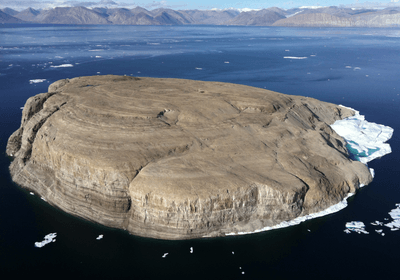


International border disputes rarely end well, but the "whisky war" of Hans Island is a masterclass of how armed conflict can be dodged through diplomacy, pedantic pettiness, and bottles of hard liquor.
The conflict (if it can be called a conflict) centered on Hans Island, a hockey puck-shaped rock in the high Arctic, surrounded by icy waters between the Canadian territory of Nunavut and the Danish territory of Greenland.
Truth be told, it's a pretty unremarkable place. Some believe Greenland Inuit used Hans Island as a vantage point for hunting, but it has long been uninhabited and largely devoid of life. Even plants struggle to find a reason to be on this 1.2-square kilometer (0.5-square mile) slab of rock.
It wasn’t until the 1970s that scientific interest in the Arctic started to regrow, and territorial claims surged among Arctic-bordering nations. Canada initially claimed the island, but the Kingdom of Denmark contested it. The former believed the island was included in their 1880 purchase of Hudson's Bay Company land, while the latter maintained it was historically part of the local Greenlandic Inuit population's territory.
In 1973, the two countries signed a treaty to iron out the fiddly disputes over their boundaries and rights in the Arctic, but the question of Hans Island's sovereignty remained unresolved. The awkward matter of the barren rock almost seemed too trivial to risk upsetting each other over, so it was simply left to be dealt with later.
In the early '80s, a new complication threatened to stir up the peace. Dome Petroleum, a Canadian fossil fuel company, quietly carried out a scientific survey on Hans Island, apparently without the Canadian government's knowledge. When the Danes caught wind of the mission through a media report, they were not pleased. However, Tom Høyem, Denmark's Minister of Greenland Affairs at the time, was convinced he knew how to handle it with his own brand of eccentric diplomacy.
“I was a little nervous. Such a border dispute could potentially be quite serious, and I knew that we would probably attract a lot of attention,” Høyem told Danish broadcaster TV 2 Nyheder in 2022.
He persuaded Prime Minister Poul Schlüter and Foreign Minister Uffe Ellemann-Jensen to let him deal with the matter personally. “We got irritated and took action,” he said.
So in July 1984, Høyem and a small team flew directly to the island by helicopter, planted a Danish flag and left a bottle of brandy.
“When we landed on the island, we built a stone cairn where we could put a flagpole and hoist the Dannebrog [Denmark’s flag]. On that stone cairn, I placed the [brandy] and a handwritten little card that said that everyone who comes by is welcome to have a glass, including Canadians. We thought that was funny, because no one comes by out there,” Høyem added.
The handwritten note reportedly also held a clearer message: “Velkommen til den danske ø”, which translates to “Welcome to the Danish Island.”
The Canadians responded with an equally polite retort. When they visited the island, their representatives left a Canadian flag, a sign reading “Welcome to Canada", and a bottle of whisky.
This tit-for-tat exchange continued for years. Any time someone visited the island, they would remove their rival’s flag and liquor bottle, replace them with their own, leave a sarcastic note, and then unceremoniously leave.
As close trading partners and NATO allies, the risk of armed conflict was low. Both knew, or at least hoped, a war wouldn’t break out over these petty pokes, so the tradition kept on going for several decades. By 2005, both parties had decided this game had gone on long enough, although it would take another 17 years to actually do something about it.
The solution, when it was finally reached in 2022, was simple: split the island in two from north to south along a natural ridge line, with each country taking a roughly half. They signed the agreement in Ottawa, exchanged bottles of liquor for one last time, and that was that.
The “whisky war” of Hans Island has been celebrated as a model for how nations can resolve territorial disputes without violence, but through diplomacy. Sure, the stakes were relatively low, and Canada and Denmark were long-standing allies, but then again, wars have been waged for less.
“It is possible to settle a disagreement, and it’s always best to do it through principles and norms that both parties recognize,” Mélanie Joly, then-Canada’s Minister of Foreign Affairs, said in 2022 after signing off the deal.
“When there are things you’re disputing over, you have to make the resolution based on international law, not by the law of force, but by the force of law,” Jeppe Kofod, at the time Denmark's Minister of Foreign Affairs, added.


 6
6