Humans
 PUBLISHED
 1
1





Once upon a time, an Australian army took a stand against the forces of birdkind, and the feathered enemy won. No, I’m not submitting a synopsis for a historical fantasy novel; I'm describing an actual historical event: The Great Emu War of 1932.
So, I’ll level with you, when I say “an army”, I don’t mean hordes of soldiers… I mean three men – an officer, Major G. P. W. Meredith, and two gunners, Sergeant S. McMurra and the aptly named Gunner J. O’Halloran. And when I say “took a stand”, I don’t mean they were holding back some existential threat per se, but rather a force that was making agriculture more difficult for settlers during the post-First World War period.
In order to understand what was going on, we have to take a few steps back.
Soldiers to farmers
Following the end of the First World War, thousands of Australian soldiers returned home. They were weary, deeply traumatized, and many had wounds that would impact their future job prospects. Of course, this situation wasn't unique to Australia; governments across the world had sent soldiers to participate in the “The Great War” and found themselves having to account for these veterans.
The way Australia chose to manage this was through its “Soldier Settlement Scheme”. Effectively, the state and federal governments agreed to transform the returned soldiers from combatants into farmers. This was built on some existing cultural groundwork, as throughout the late 19th and early 20th centuries, Australia had romanticized the “yeoman” – someone who held and cultivated a small land estate – as a virtuous ideal.
Concurrently, efforts had been made to populate the Australian inland by breaking up large areas of pastoral land into smaller farms. So, when the Soldier Settlement Scheme was introduced in 1916, it was an ideological and structural evolution of existing societal trends.
Was it effective? No, the whole initiative was pretty much a failure. Although many veterans were given plots of land to turn into their own little kingdoms, much of this was in areas with poor soil quality. At the same time, many of the resettled soldiers had little experience or agricultural knowledge. Although there was some initial success for those who grew wheat, the Great Depression of the 1920s saw an end to it. And while the Australian federal government had pledged to subsidize the soldiers' crops, they ultimately failed to follow through.
…And then the birds came
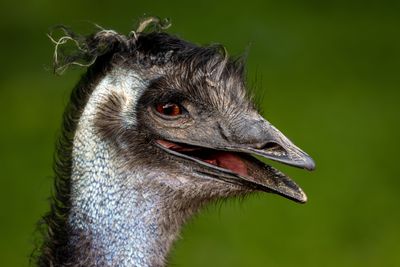
Emus are decidedly comical creatures, at least in their appearance, yet you can see how they might constitute a terrifying force when gathered in flocks numbering tens of thousands of birds.
Emus are the second largest bird in the world and they are only found in the wild in Australia. They have long necks and shaggy brown plumage that makes them look like they’re wearing fur coats. They’re nomadic and known to migrate great distances after breeding season. And they are also omnivorous, willing to eat flowers, fruits, seeds and shoots as well as small animals and insects.
During the late 1920s and the early 1930s, an enormous flock was migrating across Western Australia when they wandered into new farmland rich in food and water. Of course, the large birds decided to indulge in this newfound bounty, and as they did, they trampled down the enclosures farmers had erected to keep rabbis at bay. This is because emus, like many of their feathered kin, have very little regard for human land ownership laws.
For the farmers, this was too much. The depression had already exacted a terrible toll on their incomes and food supplies. So after demanding action, the federal government agreed to send soldiers to address the problem. And by soldiers, we now know who they meant.
The three soldiers they dispatched were armed with Lewis machine guns and 10,000 rounds of ammunition. This was exactly what the settler farmers wanted to see – they knew the potency of these weapons from their own wartime experiences. But it wasn't enough.
First, the weather got in the way. Rain caused the birds to scatter, so locals tried to herd them into an ambush, but to no avail. In another attempt, the attackers' gun jammed. They then tried to shoot the birds from their truck, but it was too slow and the rough terrain made it impracticable.
After a week of failed efforts, morale was dropping (unlike the birds). If anything, the enemy seemed to be adapting to the situation. An army observer apparently noted that the emu’s had established a new order where a leader – a large “six feet high” animal – would keep watch while the others went about their feasting and destruction.
Very few emus were actually killed by the trio’s offensives, and by November 8, 1932, a matter of days after the whole campaign started, they accepted defeat. They later returned for another effort on November 13, and, over the next month, managed to kill around 100 emus each week. This meager kill count was massively outweighed by the sheer cost ammunition. It was ultimately an ineffective approach.
Did this mean the emus won the day? Well, they survived the ramshackle efforts of the three soldiers in this little war, but their days were numbered. In 1934, rifle-wielding farmers in Western Australia claimed the lives of 57,034 birds over a six-month period (these shootings were encouraged by bounty payments).
Today, the emu population is kept at bay by a 135-mile-long fence that extends around the wheat-growing areas of Western Australia. The fence, which cost £52,000 (between $1.4m and $1.95m in today's money, as estimated by Popular Science) has been extended multiple times since its first construction. Although this has stopped the need for recurrent emu culls, it has also caused significant damage to native species in the area and disturbed migration patterns.
The Great Emu war may look like an absurd moment in history, but it is a good example of how humanity will often fumble its attempts to deal with nature at a cost to everyone – bird or farmer – involved.